Back-End Equipment
Back-end equipment is the collective term for the machines used after wafer processing is complete. They test the chips on the wafer, thin and dice the wafer into individual dies, attach and connect each die to a package, encapsulate it, and run the final electrical test that decides which parts can be shipped.
Also called: back-end semiconductor equipment, assembly and test equipment
Diagram
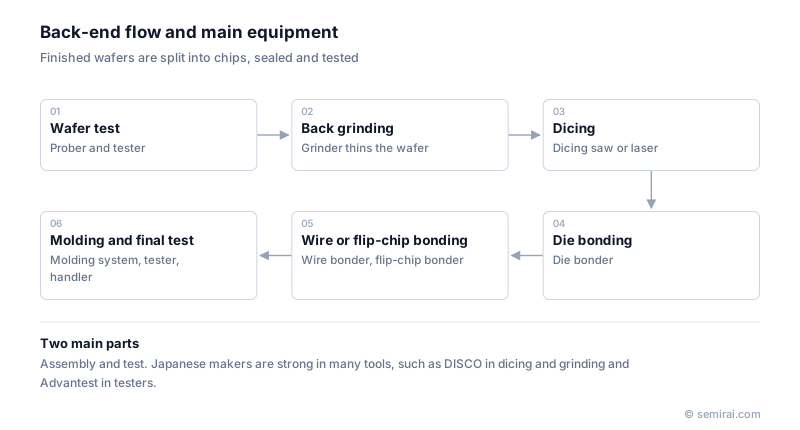
Assembly and test
The back end divides into assembly and test. In assembly, a grinder thins the wafer from the back side, a dicing saw or laser separates it into dies, a die bonder places each die on a lead frame or substrate, and a wire bonder or flip-chip bonder makes the electrical connections. A molding system then encapsulates the die in resin to protect it.
Test happens twice. Wafer probers bring probe cards into contact with every chip on the finished wafer so that a tester can screen out bad dies before assembly. After packaging, automated test equipment (ATE) and handlers test each part again under the specified conditions, often at several temperatures.
How advanced packaging changes the back end
Advanced packaging blurs the line between front end and back end. Chip-on-wafer (CoW) and wafer-on-wafer (WoW) bonding, fan-out wafer-level packaging and 2.5D or 3D integration on silicon interposers are all done at wafer level, with alignment, cleanliness and flatness requirements close to those of the fab.
As a result, back-end lines now use tools that were once front-end only, such as lithography, plating and CMP, alongside new tools for hybrid bonding and thermocompression bonding. Test is also becoming harder, because large AI and logic chips need longer test times and stacked dies must be checked before they are combined.
Japanese companies involved
- DISCO makes dicing saws, laser dicers and grinders used to thin and separate wafers, and Tokyo Seimitsu (ACCRETECH) makes wafer probers as well as dicing and grinding machines.
- Advantest builds automated test equipment for SoC and memory chips, and TOWA makes molding systems that encapsulate dies in resin.
- Tokyo Electron also supplies wafer probers used for testing chips before dicing.
- Tokyo Seimitsu (ACCRETECH) · Wafer probers, dicing and grinding machines, metrology
- TOWA · Molding (encapsulation) equipment for chip packaging
- Tokyo Electron (TEL) · Coat/develop, etch and deposition equipment
- DISCO · Dicing, grinding and polishing equipment
- Advantest · Automated test equipment (ATE) for SoC and memory
FAQ
Is back-end equipment the same as BEOL equipment?
No. BEOL (back-end of line) is the interconnect part of wafer processing inside the fab. Back-end equipment refers to packaging and test after the wafer leaves the fab. The similar names cause frequent confusion.
Why are chips tested both before and after packaging?
Wafer test removes bad dies early, so the cost of packaging them is not wasted. Final test after packaging catches failures introduced by assembly and checks the chip under its full operating conditions.
Where is back-end work usually done?
Much of it is done by outsourced semiconductor assembly and test (OSAT) companies, often in Taiwan, China and Southeast Asia, although chipmakers and foundries also run their own lines, especially for advanced packaging.
Comparisons
Related pages
Sources
Last updated: November 2, 2026