Breakdown Voltage
Breakdown voltage (BVDSS for a MOSFET) is the highest voltage a power semiconductor can withstand in the off state. Above it, avalanche breakdown makes current rise sharply, and in many cases the device then overheats and is destroyed. It is one of the first ratings checked when a power device is selected.
Also called: BVDSS, blocking voltage, voltage rating
Diagram
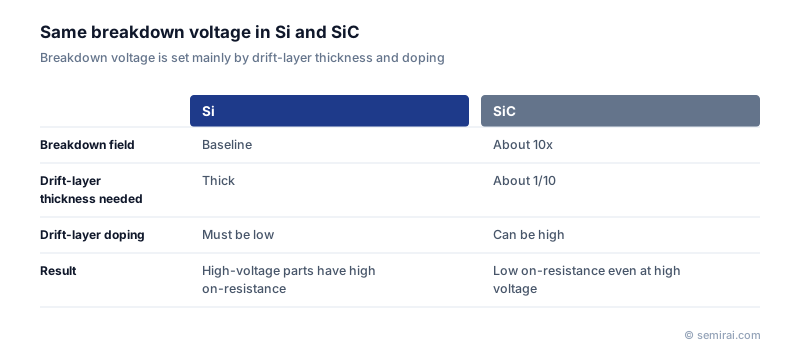
What sets the breakdown voltage
In the off state the voltage is held across a depletion region in the drift layer. A thicker, more lightly doped drift layer spreads the electric field over a longer distance, so the peak field stays below the material's critical field at a higher voltage. The same choices, however, raise the resistance the current sees when the device is on.
This trade-off between breakdown voltage and on-resistance is the central problem of power device design. For silicon, on-resistance rises much faster than linearly with the voltage rating, which is why silicon MOSFETs become impractical at high voltages and IGBTs or super-junction structures take over.
Why the material matters
A different semiconductor moves the trade-off itself. Silicon carbide has a critical field about ten times that of silicon, so the same breakdown voltage needs a drift layer roughly one tenth as thick, which can also be doped much more heavily. The result is far lower on-resistance at a given rating, and it is why SiC MOSFETs are replacing silicon IGBTs in the 1200 V class.
Real devices do not reach the ideal value of a flat, infinite junction. The field concentrates at the edge of the chip, so termination structures such as guard rings or junction termination extension (JTE) are added to spread it. The quality of this edge design largely decides the breakdown voltage and long-term reliability that a device actually achieves.
Japanese companies involved
- Mitsubishi Electric and Fuji Electric design high-voltage IGBT and SiC power devices, including the edge termination that lets them reach their rated breakdown voltage.
- Mitsubishi Electric (power devices) · IGBT and SiC power modules, RF and optical devices
- Fuji Electric (power semiconductors) · IGBT modules and SiC power devices
FAQ
How much margin should the breakdown voltage have?
A common rule is to choose a device rated at about 1.5 to 2 times the working voltage, to cover switching surges. For example, 650 V devices are typical in 400 V systems and 1200 V devices in 800 V systems.
What is avalanche breakdown?
Carriers accelerated by a strong electric field hit the crystal lattice hard enough to create new electron-hole pairs, which are accelerated in turn, so the number of carriers multiplies like an avalanche. Zener and avalanche diodes use this effect deliberately to clamp voltage.
Does breakdown voltage change with temperature?
Yes. Avalanche breakdown voltage rises with temperature in silicon and SiC, because carriers scatter more and gain less energy between collisions. Datasheets therefore state the rating at a given temperature, and low-temperature operation needs extra margin.
Comparisons
Related pages
- Power Semiconductor
- SiC MOSFET (Silicon Carbide MOSFET)
- IGBT (Insulated Gate Bipolar Transistor)
- Wide Bandgap Semiconductor (WBG)
- PN Junction
- Super Junction MOSFET
- Silicon Carbide (SiC)
- Trench MOSFET
- Power semiconductor manufacturing equipment
- Advantest EXAVIS
- Advantest MT100 / MT200
- Hitachi High-Tech M-600 / 6000 series
Sources
Last updated: November 2, 2026