Avalanche Photodiode (APD)
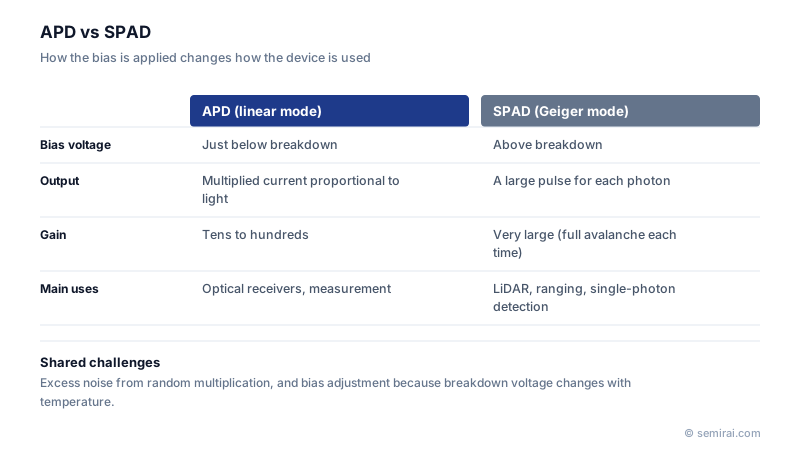
An avalanche photodiode (APD) is a high-sensitivity photodiode that multiplies the carriers created by light, much like an avalanche, and so delivers a large current from weak light. It is operated with a large reverse voltage close to the breakdown voltage, where the internal electric field is strong enough to multiply carriers.
Also called: APD, SPAD, single-photon avalanche diode
Diagram
How avalanche multiplication works
In a strong electric field, an electron gains enough energy to knock a new electron-hole pair out of the lattice (impact ionisation). The new carriers are accelerated in turn and create more pairs. This chain can multiply each photo-generated electron tens to hundreds of times, so an APD detects light too weak for an ordinary photodiode.
Silicon APDs cover visible to near-infrared light, about 400 to 1,100 nm. InGaAs APDs cover the 1.3 to 1.55 µm wavelengths used in optical fibre communication.
SPADs and practical limits
Biased above breakdown, the diode enters Geiger mode: a single photon sets off a self-sustaining avalanche and a large pulse. Such a device is called a single-photon avalanche diode (SPAD). Because it can time the arrival of individual photons precisely, it is used in direct time-of-flight (dToF) LiDAR and smartphone ranging sensors, and image sensors built from arrays of SPADs are now on the market.
Two drawbacks are common to APDs and SPADs. Random variation in the multiplication adds excess noise, and the breakdown voltage changes with temperature, so the bias must be adjusted as temperature changes.
Japanese companies involved
- Hamamatsu Photonics makes silicon and InGaAs APDs as well as photon-counting detectors based on avalanche multiplication.
- Hamamatsu Photonics · Failure analysis, process monitoring and static elimination equipment
FAQ
How is an APD different from an ordinary photodiode?
An ordinary photodiode produces at most one electron of current per absorbed photon. An APD multiplies that charge inside the device, giving a much larger signal from weak light. The cost is a high operating voltage, temperature sensitivity and extra noise from the multiplication process.
Why does a SPAD need a quenching circuit?
Above breakdown, an avalanche keeps going once it starts. A quenching circuit detects the pulse and briefly lowers the voltage below breakdown to stop it, then restores the bias so the diode is ready for the next photon. The recovery time limits how many photons a SPAD can count per second.
Related pages
Sources
Last updated: November 1, 2026