ATPG (Automatic Test Pattern Generation)
Automatic test pattern generation (ATPG) is the technique by which electronic design automation (EDA) tools take a circuit netlist and a set of fault models and automatically produce test patterns that can detect manufacturing defects. Writing patterns by hand for chips with hundreds of millions of transistors is impossible, so testing of modern digital chips depends on ATPG.
Also called: automatic test pattern generation
Diagram
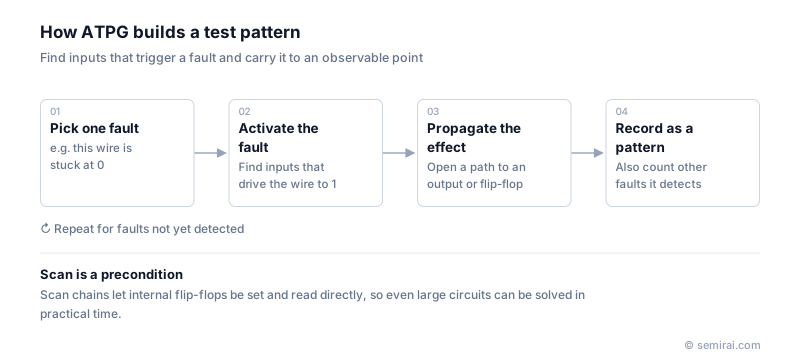
Activate and propagate
ATPG works fault by fault. For each target fault the tool searches for input values that first activate the fault and then propagate its effect to a point that can be observed. To detect a wire stuck at 1, for example, the inputs must try to drive that wire to 0, and a path must be sensitised so the difference reaches an output or a scan flip-flop.
Classic search methods include the D-algorithm and PODEM. Each pattern found is also simulated against the other faults, because one pattern usually detects many of them, and the tool moves on to faults that are still undetected.
Why scan makes ATPG possible
For purely combinational logic the search is manageable. In sequential circuits, however, reaching a particular internal state may need a long series of inputs, and the search explodes. Scan chains let the tester set and read every flip-flop directly, which turns the problem back into combinational test generation. That is why DFT and ATPG are always discussed together.
Results are judged by fault coverage and pattern count. Higher coverage gives better quality, but more patterns mean longer test time and more tester memory. Test compression, which expands a small amount of external data inside the chip to fill many short scan chains, is the standard way to reduce the data volume by an order of magnitude or more.
Japanese companies involved
- The patterns produced by ATPG are run on automatic test equipment, such as testers from Advantest, which applies them to each chip and compares the responses with the expected values.
- Advantest · Automated test equipment (ATE) for SoC and memory
FAQ
Which fault models does ATPG use?
The basic one is the stuck-at model, where a node is fixed at 0 or 1. Others include bridging faults between neighbouring wires, and transition and path-delay faults that catch defects which only show up at full speed. At advanced nodes the timing-related models matter more.
Who makes ATPG tools?
The major suppliers are Synopsys, Cadence and Siemens EDA. Their tools are usually run after scan and compression have been inserted, and they report the coverage achieved for each fault model.
Related pages
Sources
Last updated: November 2, 2026