Bathtub Curve / FIT Rate
The bathtub curve is the shape a product's failure rate takes when plotted over time: high at first (early failures), then low and roughly constant (random failures), then rising again at the end of life (wear-out). Semiconductor reliability work is organised around applying a different method to each of these three periods.
Also called: bathtub curve, FIT, failures in time
Diagram
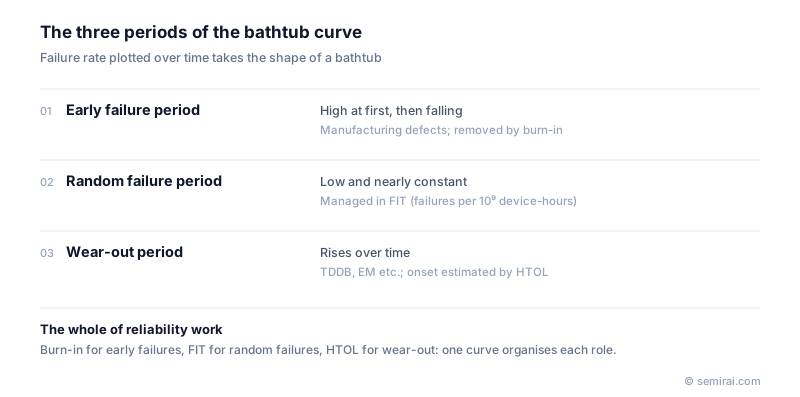
The three periods
Early failures come from units with latent manufacturing defects that give way soon after use begins. They are removed before shipment by burn-in: stressing devices at high temperature and voltage so that weak units fail in the factory. In effect, the left edge of the bathtub is cut off before the parts reach customers.
During the random-failure period the rate is low and nearly constant. Wear-out comes later, when physical degradation mechanisms such as time-dependent dielectric breakdown (TDDB), negative bias temperature instability (NBTI), hot-carrier injection (HCI) and electromigration have accumulated. Accelerated life tests such as HTOL check that wear-out begins well after the product's intended lifetime, using models such as the Arrhenius equation to convert test hours into years of use.
FIT: measuring the random failure rate
The random failure rate is expressed in FIT (failures in time), the number of failures per one billion device-hours. One FIT means one failure in 10⁹ device-hours, which corresponds to a mean time between failures (MTBF) of about 114,000 years for a single device. The small unit is needed because individual chips fail very rarely.
FIT values add up across a system: a board with hundreds of components has a total failure rate equal to the sum of their FITs. Automotive and industrial customers therefore set FIT targets for each component and use them in functional safety calculations under standards such as ISO 26262.
Japanese companies involved
- ESPEC supplies the temperature chambers and burn-in systems used to screen early failures and run life tests across the curve.
FAQ
How is a FIT rate calculated from a life test?
The number of failures observed in an accelerated test is divided by the total device-hours, after the hours are multiplied by the acceleration factor for the test conditions. Because few or no failures are usually seen, a statistical confidence limit, often based on the chi-squared distribution, is applied. JEDEC JESD85 describes such methods.
Does every product follow a bathtub curve?
It is an idealised model. Real data may show a very small early-failure region after good screening, or wear-out that never appears within the useful life. The value of the curve is that it links burn-in, FIT targets and life testing in one picture.
Comparisons
Related pages
- Burn-In Test
- HTOL (High Temperature Operating Life)
- Acceleration Model / Arrhenius Equation
- DPPM (Defective Parts Per Million)
- Time-Dependent Dielectric Breakdown (TDDB)
- Electromigration (EM)
- Failure Analysis (FA)
- Weibull Distribution
- Final test equipment
- Advantest 7038 System-Level Test System
- Advantest T2000
- DISCO DIS100
- Tokyo Electron (TEL) Prexa™ SDP
Sources
Last updated: November 2, 2026