Capacitance Manometer
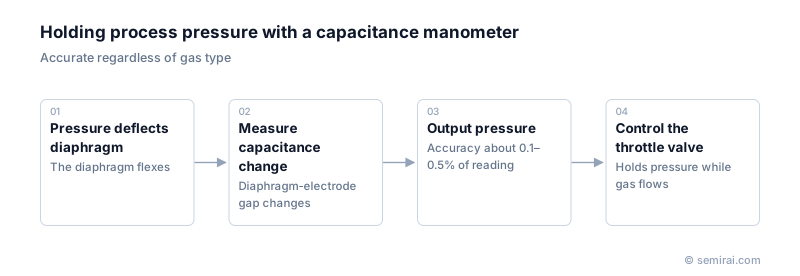
A capacitance manometer, or capacitance diaphragm gauge, measures pressure from the tiny deflection of a thin metal or ceramic diaphragm under a pressure difference. The deflection is read as a change in capacitance between the diaphragm and a facing electrode. Because it measures the force on the diaphragm directly, its reading does not depend on the type of gas.
Also called: capacitance diaphragm gauge, CDG, diaphragm gauge
Diagram
Range and accuracy
One gauge covers roughly four to five decades below its full-scale pressure. Users therefore choose models with different full scales, such as 1,000 Torr, 10 Torr, 1 Torr or 0.1 Torr, to suit the application.
Accuracy is high, typically around 0.1–0.5% of reading. Heated versions keep the sensor at a constant elevated temperature so that process gases do not condense or deposit on the diaphragm, and to improve stability.
Role in process control
On semiconductor tools, the capacitance manometer is the standard gauge for controlling chamber pressure in dry etching, CVD and ALD. The gauge reading feeds a controller that adjusts a throttle valve on the exhaust side, holding a constant pressure while gas flows.
Process gases are mixtures that change from step to step, so gauges whose reading depends on gas species, such as Pirani or ionisation gauges, cannot be used for this control.
Japanese companies involved
- ULVAC makes capacitance manometers, and Canon ANELVA also makes vacuum gauges for process equipment.
- Canon ANELVA · Sputtering and vacuum deposition equipment
- ULVAC · Vacuum deposition (sputtering) equipment and vacuum pumps
FAQ
Why is the capacitance manometer used for process pressure control?
Etch and CVD recipes mix several gases, and the mix changes between steps. Pirani and ionisation gauges read differently for each gas, but a capacitance manometer measures force on a diaphragm, so it gives the true pressure whatever the gas. That makes recipes reproducible from tool to tool.
What does full scale mean?
Full scale is the highest pressure a gauge can measure. A capacitance manometer reads accurately from full scale down to about four to five decades below it. Tools often combine two gauges with different full scales to cover both the process range and the base pressure.
Related pages
Sources
Last updated: November 2, 2026