Anisotropic Conductive Film (ACF)
Anisotropic conductive film (ACF) is an adhesive film containing small conductive particles dispersed in insulating resin. After bonding it conducts electricity only through its thickness, between facing electrodes, while staying insulating sideways between neighbouring electrodes, so it can connect many fine-pitch terminals at once.
Also called: ACF, anisotropic conductive adhesive
Diagram
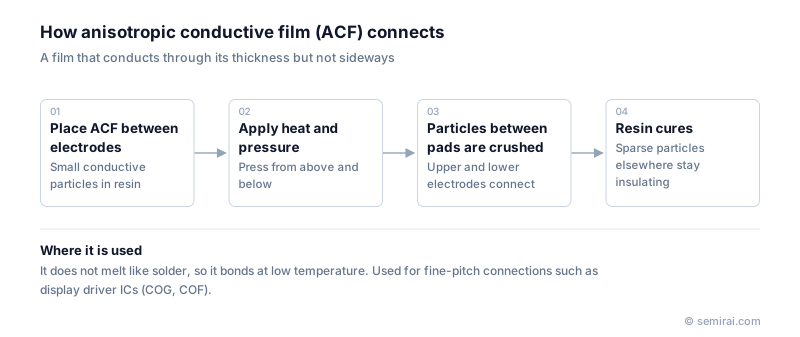
How it works
The film is placed between two sets of electrodes, for example the bumps of a driver chip and the pads on a glass panel. Heat and pressure are applied. The resin softens and flows away from the electrode areas, and the particles caught between each pair of facing electrodes are compressed into contact with both, creating a conductive path. Elsewhere the particles remain separated by resin, so neighbouring electrodes are not shorted. The resin then cures and holds the parts together mechanically.
The particles are typically plastic spheres coated with nickel and gold, or metal particles. Their size and density must be balanced: enough particles must be trapped on each small electrode, but not so many that they form bridges sideways.
Where ACF is used
ACF bonds at lower temperatures than solder and needs no flux or cleaning, which makes it suitable for glass and plastic films. Its main use is in displays: chip on glass (COG) and chip on film (COF) mounting of driver ICs, and connecting flexible printed circuits to panels. It is also used for camera modules, touch panels and some flip-chip assemblies.
ACF joints have higher resistance than solder and cannot carry large currents, and they are less robust mechanically, so ACF is not used for the fine-pitch bumps of high-performance logic packages.
Japanese companies involved
- Dexerials and Resonac are major Japanese suppliers of anisotropic conductive films for display and electronics assembly.
- Resonac · CMP slurries, packaging materials and SiC epitaxial wafers
FAQ
Why is it called anisotropic?
Anisotropic means having different properties in different directions. The film conducts in the vertical (Z) direction through compressed particles but insulates in the horizontal (X and Y) directions, unlike an isotropic conductive adhesive that conducts in all directions.
What can cause ACF connection failures?
Too few particles trapped on an electrode, insufficient pressure or temperature, incomplete resin cure, and moisture or temperature cycling that weakens adhesion. Peeling and rising contact resistance over time are the typical failure modes.
Related pages
Sources
Last updated: November 13, 2026