Coplanarity
Coplanarity is a measure of how well the lead tips or solder ball bottoms of a package lie in the same plane. It is usually expressed as the largest distance of any terminal from the seating plane, the plane on which the package rests on a flat surface. A smaller value means more even terminal heights.
Also called: lead coplanarity, ball coplanarity
Diagram
Why it matters for soldering
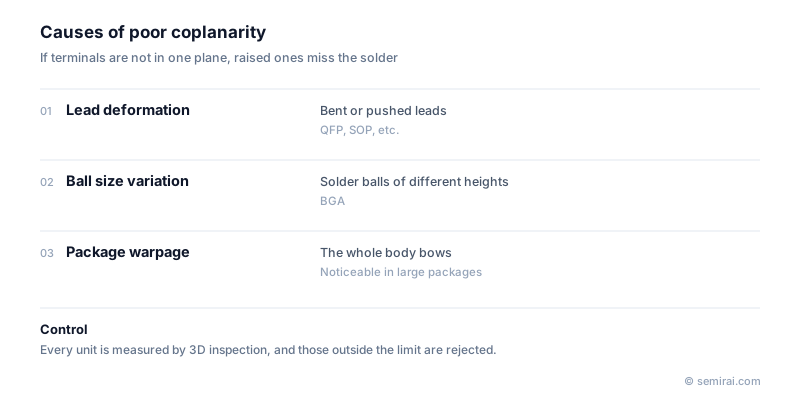
In surface mounting, solder paste is printed onto the board pads, the package is placed on top and the assembly is reflowed. If terminals are uneven, the raised ones may never touch the paste, leaving an open joint or a weak connection.
For leaded packages such as SOP and QFP, bent or deformed leads are the main cause. For BGAs, variation in ball size and warpage of the package body are the main causes. Fine-pitch and large packages are the most sensitive, because there is less solder per joint to absorb height differences.
Specification and inspection
Package outline standards such as those from JEDEC set maximum coplanarity values according to package type and pitch, typically on the order of tens of micrometres up to around 0.1 mm.
Before test or shipment, 3D inspection systems using lasers or cameras measure the height of every terminal of every package, and units outside the limit are rejected. Careful handling in transport and in trays also matters, because a single knock can bend a lead.
Japanese companies involved
- Shinko Electric Industries makes leadframes and package substrates, whose flatness and dimensional accuracy feed directly into the coplanarity of finished packages.
- Shinko Electric Industries · FC-BGA package substrates and lead frames
FAQ
How is the seating plane defined?
It is the plane on which the package would rest if placed on a perfectly flat surface, typically defined by the three lowest terminals that support it. Coplanarity is then the largest gap between this plane and any other terminal.
Can poor coplanarity be fixed after moulding?
For leaded packages, lead straightening is sometimes possible, but it risks damaging the leads and is avoided in volume production. For BGAs, warpage-related coplanarity must be addressed in package design and materials, since it cannot be corrected afterwards.
Related pages
Sources
Last updated: November 13, 2026