Cavity
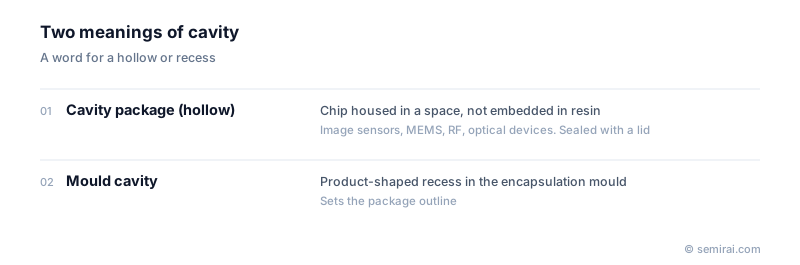
Cavity means a hollow or recess, and in semiconductors it has two common uses. A cavity package (hollow package) holds the chip in an open space instead of embedding it in resin. A mould cavity is the product-shaped recess inside an encapsulation mould, into which molten resin flows to form the package body.
Also called: cavity package, hollow package, mould cavity
Diagram
Cavity packages
Cavity packages are used when resin touching the chip surface would cause problems. Image sensors need a clear path for light. MEMS devices such as accelerometers and microphones have moving parts. RF devices can be detuned by the dielectric constant of resin, and optical devices such as laser diodes need an open optical path.
One approach places the chip in a ceramic package and seals it with a lid. Another builds a wall on an organic substrate and caps it. The inside may be filled with dry nitrogen and hermetically sealed to keep out moisture.
Mould cavities
In transfer moulding and compression moulding, the mould cavity defines the outer shape of the package. In transfer moulding, compound melted in a pot is pushed through runners and gates into each cavity and cured.
Cavity dimensions, surface finish and flow design affect package dimensions and appearance, as well as internal voids and wire sweep, where the flow pushes bond wires sideways. Resin left over in the pot after each shot, the cull, is separated and discarded.
Japanese companies involved
- Kyocera makes ceramic packages, including cavity types sealed with lids for sensors and optical and RF devices.
- TOWA and Apic Yamada build moulding equipment and moulds whose cavities shape the bodies of plastic packages.
- Kyocera · Package substrates and ceramic components
- TOWA · Molding (encapsulation) equipment for chip packaging
- Apic Yamada (Yamaha Robotics) · Molding (encapsulation) equipment for semiconductor packages
FAQ
Is a cavity package always hermetic?
No. Ceramic and metal packages sealed by welding or glass can be truly hermetic. Organic cavity packages with glued lids keep out dust and liquid but allow slow moisture diffusion, which is acceptable for many consumer sensors.
What is the difference between a cavity and a gate?
The cavity is the recess that forms the package body. The gate is the narrow entrance through which resin flows from the runner into the cavity. Gate position and size strongly affect how the cavity fills and where air must be vented.
Related pages
Sources
Last updated: November 13, 2026