Underfill
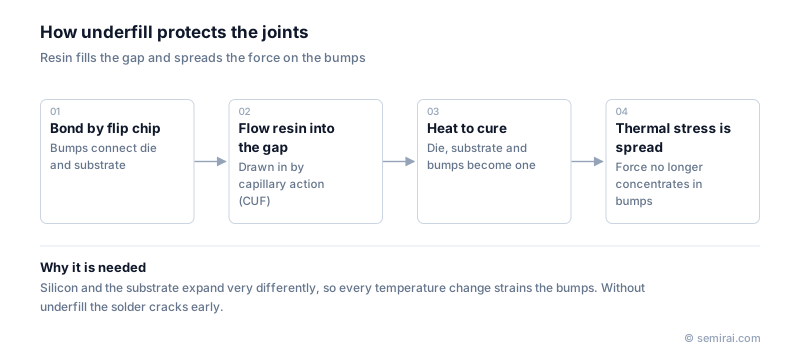
Underfill is a resin that fills the narrow gap between a flip-chip die and its substrate, or between stacked dies, and bonds them together. Silicon and organic substrates expand very differently with temperature, and underfill spreads the resulting stress across the whole area instead of letting it concentrate in the small solder joints.
Also called: capillary underfill (CUF), molded underfill (MUF), NCF
Diagram
Ways of applying underfill
In capillary underfill (CUF), the die is first bonded, then liquid resin is dispensed along one or two edges and drawn into the gap by capillary action before being cured. It is the traditional method, but becomes slow and prone to voids as gaps get narrower and dies larger.
Pre-applied underfills are placed before bonding. Non-conductive paste (NCP) is dispensed on the substrate, and non-conductive film (NCF) is laminated onto the wafer; during thermocompression bonding the bumps push through the material and it cures at the same time. NCF is widely used for stacking HBM and other memory dies. In molded underfill (MUF), the mold compound used for encapsulation also fills the gap in one step, which saves a process but requires a compound with very fine filler.
Material design
Underfill is usually an epoxy resin filled with silica particles. The filler lowers the coefficient of thermal expansion (CTE) towards that of the solder, and the cured resin must be stiff enough to support the joints. At the same time the uncured material must flow quickly into gaps of only tens of micrometres or less, so the filler size and amount are limited.
Low cure shrinkage, strong adhesion to the die, passivation and solder mask, and resistance to moisture are also needed. Voids or delamination in the underfill leave bumps unsupported and become starting points for cracks.
Japanese companies involved
- Namics and Resonac are Japanese suppliers of underfill materials for flip-chip and stacked-die packages.
FAQ
What happens without underfill?
Each temperature change makes the die and substrate expand by different amounts, bending the solder bumps back and forth. Without underfill this repeated strain causes fatigue cracks in the joints, often after relatively few thermal cycles in large dies.
How is underfill quality checked?
Scanning acoustic microscopy is used to find voids and delamination non-destructively, and cross-sections are used in development. Reliability is confirmed with temperature cycling, high-humidity and drop tests.
Related pages
- Flip Chip
- Epoxy Molding Compound (EMC)
- Advanced Packaging
- Void (Packaging Defect)
- Anisotropic Conductive Film (ACF)
- Temperature Cycle Test (TCT)
- MSL (Moisture Sensitivity Level)
- Solder Ball
- Flip-chip bonders
- Panasonic Connect MD-P300
- Shibaura Mechatronics TFC-3600
- Shibaura Mechatronics TFC-6500
- Shibuya Corporation DB258
Sources
Last updated: November 13, 2026