Backgrinder (Back Grinding Equipment)
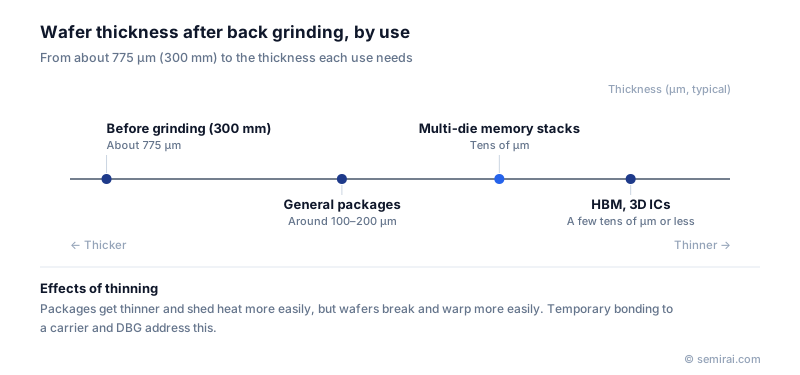
A backgrinder is a back-end machine that thins a finished wafer by grinding its back side, the side opposite the circuits, with rotating diamond wheels. It takes 300 mm wafers from about 775 µm down to the thickness the package needs, often 100 to 200 µm and for stacked dies a few tens of micrometres, with tight control of thickness, flatness and damage.
Also called: back grinding machine, wafer grinder, BG
Diagram
How a backgrinder works
The wafer, with its circuit side covered by back-grinding tape, is held face-down by a vacuum on a porous chuck table. A cup-shaped grinding wheel with diamond abrasive bonded around its rim spins at high speed and is fed down onto the rotating wafer. This in-feed grinding removes material evenly across the whole surface. An in-process gauge measures thickness continuously so the machine stops at the target.
Most systems have two spindles. The first carries a coarse wheel that removes most of the silicon fast; the second carries a fine wheel that leaves a smoother surface with shallower damage. Many backgrinders also integrate a polishing unit for dry polishing or CMP to remove the remaining damage layer, plus cleaning and tape-mounting stations, so the thin wafer is never handled bare between steps.
Key performance factors
Users judge a backgrinder by thickness variation across the wafer and between wafers, surface roughness, damage depth, which governs die strength, and throughput. Chuck table flatness, spindle stiffness and wheel dressing all affect the result. For very thin targets the machine must also handle wafers on carriers or with a TAIKO edge ring, and support dicing-before-grinding flows in which grinding completes the separation of pre-grooved dies.
Grinding hard materials
Silicon carbide, used for power devices, is far harder than silicon and wears diamond wheels quickly while grinding slowly. SiC wafers need specially designed wheels and grinding conditions, and their after-grind damage must be removed carefully, often by CMP. Sapphire and other hard substrates raise similar issues.
Japanese companies involved
- DISCO makes backgrinders and grinder-polishers, together with dicing saws and the diamond wheels they use.
- Tokyo Seimitsu (ACCRETECH) and Okamoto Machine Tool Works make wafer grinders and polishers.
- LINTEC supplies back-grinding tapes and the laminators that apply them.
- DISCO · Dicing, grinding and polishing equipment
- LINTEC · Dicing and backgrinding tapes, tape processing equipment
- Tokyo Seimitsu (ACCRETECH) · Wafer probers, dicing and grinding machines, metrology
- Okamoto Machine Tool Works · Wafer polishers and grinders
FAQ
Why is back-grinding tape needed?
The tape covers the finished circuits so the chuck table and grinding swarf cannot scratch or contaminate them, and it cushions bumps on the front surface. After grinding, it is peeled off, often after UV light has weakened its adhesive.
What happens after back grinding?
The damage layer is relieved by polishing or etching, the wafer is mounted on dicing tape on a frame, the back-grinding tape is removed and the wafer goes to dicing. For TSV wafers, backside via reveal and bumping follow while the wafer is still on its carrier.
What is the difference between grinding and polishing?
Grinding uses a rigid wheel with fixed abrasive to remove material quickly and leaves a damaged layer. Polishing uses a pad, with or without slurry, to remove a thin layer slowly and leave a nearly damage-free, mirror-like surface.
Related pages
Sources
Last updated: November 2, 2026