Coefficient of Thermal Expansion (CTE)
The coefficient of thermal expansion (CTE) is the fractional change in a material's length for each 1 K (1°C) rise in temperature. It is usually quoted in ppm/K: a material with a CTE of 10 ppm/K grows by about 10 µm over 10 mm when heated by 100 K. In packaging it normally means the linear CTE.
Also called: thermal expansion coefficient, CTE mismatch
Diagram
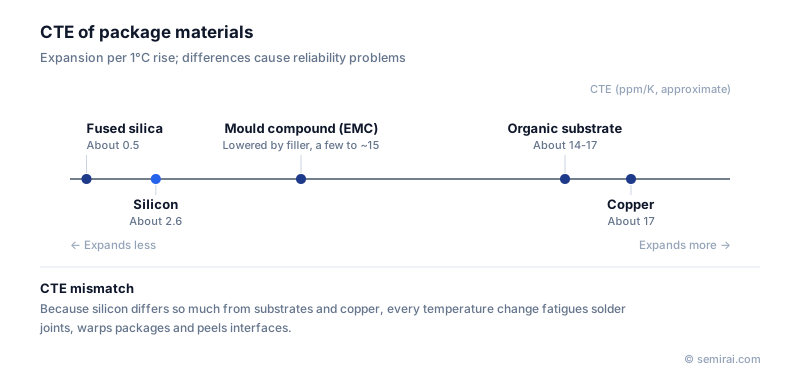
Typical values in a package
A chip and its package combine materials with very different CTEs. Approximate room-temperature values are 2.6 ppm/K for silicon, 5.7 ppm/K for gallium arsenide, 17 ppm/K for copper, 23 ppm/K for aluminium and around 20 ppm/K for lead-free solder. A standard FR-4 board expands by roughly 14-17 ppm/K in-plane.
Mould compounds are loaded heavily with silica filler to bring their CTE down, but above their glass transition temperature (Tg) they expand much more. Whenever temperature changes during manufacturing or use, these differences, known as CTE mismatch, create stress between bonded materials.
Why mismatch matters and how it is managed
CTE mismatch is the root cause of many package reliability problems. The difference between chip and board shears solder joints on every temperature cycle until fatigue cracks form. It also bends packages and substrates (warpage), cracks dies and delaminates resin interfaces. Even inside the chip, the mismatch between metal wiring and silicon can produce hillocks and voids.
Countermeasures include underfill resin that locks chip and substrate together and spreads the stress, sufficient solder joint height, low-CTE mould compounds, and interposers or substrates whose CTE is closer to silicon, such as silicon interposers and glass-core substrates.
Japanese companies involved
- Resonac and Sumitomo Bakelite formulate mould compounds and substrate materials with tuned CTE and Tg to limit warpage and stress.
- Denka supplies the silica and alumina fillers that lower the CTE of mould compounds, and IBIDEN builds package substrates where CTE matching with the die is a central design concern.
- Resonac · CMP slurries, packaging materials and SiC epitaxial wafers
- Sumitomo Bakelite · Epoxy mold compounds and package materials
- IBIDEN · IC package substrates (FC-BGA)
- Denka · Silica and alumina fillers for mold compounds
FAQ
Is CTE constant with temperature?
No. Most materials' CTE changes with temperature, and polymers change sharply at their glass transition temperature, often expanding two to four times faster above it. Datasheets therefore often give separate values below and above Tg.
Why does a board expand differently in-plane and through its thickness?
In a glass-reinforced laminate, the glass cloth restrains expansion along the plane of the board, but nothing restrains it through the thickness. The out-of-plane CTE is therefore much larger, which stresses plated holes during soldering.
Related pages
Sources
Last updated: November 2, 2026