Built-In Self-Test (BIST)
Built-in self-test (BIST) is a design-for-testability technique that places test circuitry inside a chip so that the chip generates its own test patterns and judges the results. It reduces dependence on expensive external testers and allows the chip to check itself not only in the factory but also in the field, for example at power-up.
Also called: BIST, MBIST, LBIST
Diagram
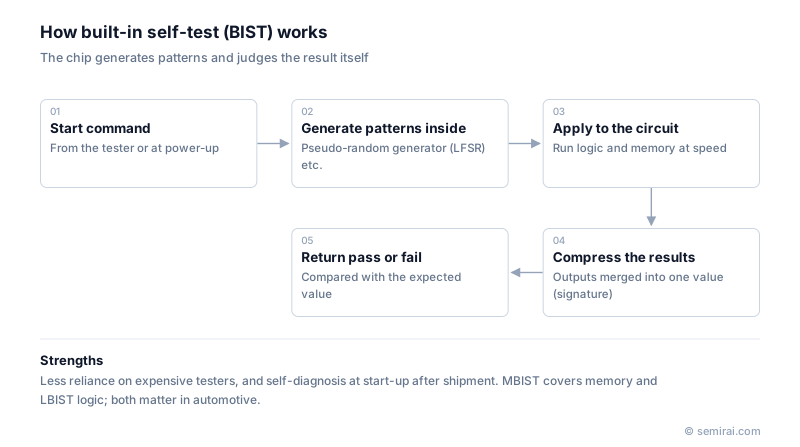
Memory BIST and logic BIST
Memory BIST (MBIST) targets embedded SRAM and other on-chip memories. A small controller writes regular sequences, known as march algorithms, into the array and reads them back to find stuck cells, coupling faults and address faults. Embedded memories are hard to reach from the pins, so MBIST is used in almost every SoC, often combined with repair using spare rows and columns.
Logic BIST (LBIST) targets random logic. A pseudo-random pattern generator, usually a linear feedback shift register (LFSR), feeds patterns into the scan chains, and the responses are compressed into a single signature. If the signature matches the expected value, the logic passes.
Benefits and costs
BIST shortens test time, needs only a few test pins, and runs at the chip's own clock speed, which helps catch timing-related defects. It also reaches circuits that are hard to access from outside.
Its biggest role today is in-field self-test. Functional safety standards for vehicles, such as ISO 26262, expect safety-related chips to detect faults during their life, and BIST can run at start-up or periodically to do this. The price is extra area for the test logic and design effort to make the logic friendly to random patterns. In practice BIST is used together with scan-based testing on ATE rather than replacing it.
Japanese companies involved
- Production test of chips with BIST still runs on automatic test equipment, such as Advantest's SoC and memory testers, which starts the self-test and reads back the result.
- Advantest · Automated test equipment (ATE) for SoC and memory
FAQ
Does BIST make external testers unnecessary?
No. A tester is still needed to supply power and clocks, start BIST, read the result and run parametric and scan tests. BIST reduces the data and time the tester must handle rather than eliminating it.
Why is LBIST harder than MBIST?
Memories have a regular structure, so a short deterministic algorithm can cover them well. Random logic contains faults that pseudo-random patterns rarely hit, so designers add test points and accept lower coverage, or top it up with patterns from ATPG.
Related pages
Sources
Last updated: November 2, 2026