Cost of Test (COT)
Cost of test (COT) is the cost of testing one semiconductor chip. It is calculated by dividing the depreciation of the tester, prober and handler, consumables such as probe cards and sockets, and operating and labour costs by the number of chips the equipment tests. For some products it is a significant share of total manufacturing cost.
Also called: test cost, COT
Diagram
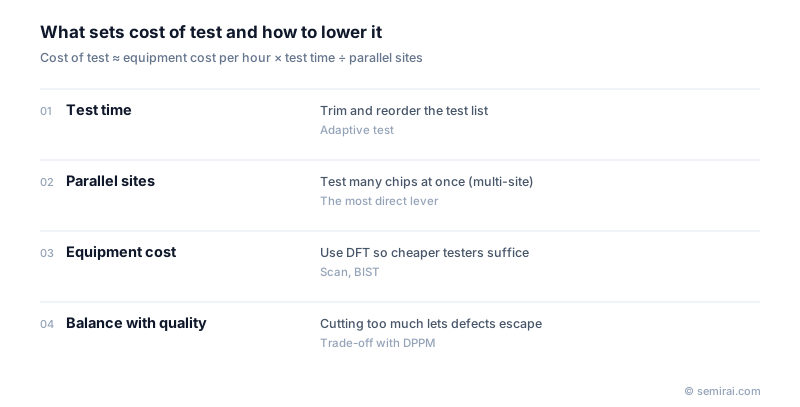
What drives the cost
A useful approximation is: cost of test = equipment cost per hour × test time per chip ÷ number of chips tested in parallel. Equipment utilisation and the share of parts that need a retest also matter, because idle or repeated tester time is paid for in the same way.
This gives three main levers. Test time can be shortened by removing or reordering tests and by test compression. Parallelism can be raised by multi-site testing, which touches down on many chips at once. Equipment cost can be lowered with design-for-test (DFT) features such as built-in self-test (BIST), which reduce the performance the tester must provide.
The trade-off with quality
Cutting tests reduces time and cost but raises the risk that defective parts escape, which worsens the defective-parts-per-million (DPPM) figure. Products for cars go the other way: they add testing at several temperatures, burn-in and system-level test (SLT), so their cost of test is higher. Deciding how much to test is a business decision that depends on the application and the selling price.
New pressures on test cost
Large AI GPUs and HBM stacks have long test times and need expensive testers for high-speed interfaces. Chiplets add another burden: each die must be proven a known good die (KGD) before stacking, because one bad die scraps the whole assembly. Responses include adaptive test, which changes the test list according to the data, and using front-end data to tune what is tested.
Japanese companies involved
- Advantest develops ATE with high pin counts and many parallel sites, the main hardware lever for lowering cost of test in high-volume production.
- Advantest · Automated test equipment (ATE) for SoC and memory
FAQ
What is the most effective way to lower cost of test?
Raising parallelism usually has the largest effect, since doubling the sites roughly halves the tester time per chip if the hardware supports it. In practice it is combined with test-time reduction and DFT, and with keeping the tester busy, because idle equipment still depreciates.
Why does automotive test cost more?
Field failures in cars are costly and can be dangerous, so automotive flows test at hot and cold temperatures, add burn-in or stress screens and apply statistical outlier removal. Each of these adds tester time or extra insertions, which raises cost per chip in exchange for lower DPPM.
Related pages
Sources
Last updated: November 2, 2026