Directed Self-Assembly (DSA)
Directed self-assembly (DSA) is a patterning technique that exploits the tendency of block copolymers to separate spontaneously into regular nanoscale domains, forming fine periodic patterns that are hard to print by lithography alone. A coarser pre-pattern made by lithography guides the orientation and placement of the domains.
Also called: DSA, block copolymer lithography
Diagram
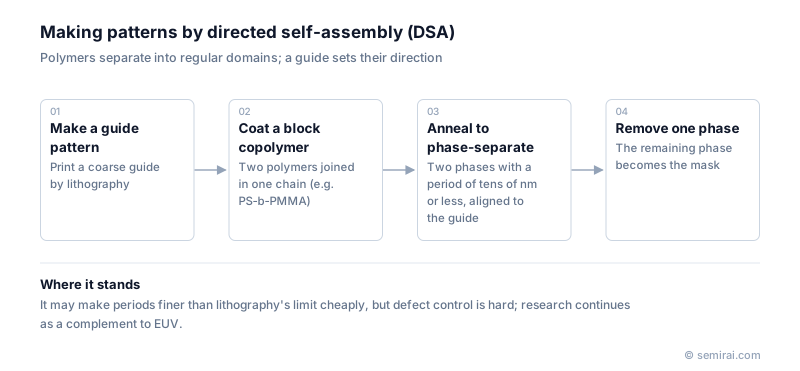
How DSA works
A block copolymer is a chain made of two chemically different polymer blocks joined end to end, for example polystyrene and poly(methyl methacrylate) (PS-b-PMMA). The two blocks do not mix, but because they are bonded together they cannot separate fully. When the film is annealed, they form lamellae or cylinders with a period set by the chain length, typically a few tens of nanometres or less.
Left alone, the domains form random fingerprint patterns. In graphoepitaxy, trenches or posts made by lithography confine the polymer and align it; in chemoepitaxy, a chemically patterned surface does the guiding. One block is then removed by etching, leaving the other as a mask for transfer to the layer below.
Uses and limits
DSA can multiply the frequency of a guide pattern, producing lines and spaces at a fraction of the lithographic pitch, and can shrink and rectify contact holes so that their size and position are more uniform than lithography alone gives. It also repairs some roughness, because the polymer domains have smooth interfaces.
The barriers have been defect density, since dislocations and misaligned domains must be reduced to levels acceptable for production, together with limited layout freedom, because only periodic shapes form naturally, and integration with inspection and etch. It has been studied mainly as a complement to multi-patterning and EUV rather than a replacement.
Japanese companies involved
- JSR has developed block copolymer materials for semiconductor patterning by self-assembly.
- Tokyo Electron has developed coating, annealing and etch processes for DSA on its track and etch equipment.
- Tokyo Electron (TEL) · Coat/develop, etch and deposition equipment
- JSR · Photoresists and semiconductor materials
FAQ
How does DSA make a pattern?
The block copolymer is coated over a lithographic guide pattern and heated. The two blocks separate into alternating domains aligned by the guide, and one block is removed so that the remaining domains act as an etch mask.
What are the advantages and drawbacks?
It can create pitches finer than the exposure tool resolves at low cost, with smooth edges. But defect rates are hard to bring down to production levels, and it only forms regular patterns, so it cannot draw arbitrary circuit layouts.
Is DSA used in production?
It has been evaluated for DRAM line-and-space patterns and for contact hole shrink, and research continues, including combination with EUV to smooth roughness. As EUV matured, however, broad adoption in volume manufacturing has not taken place.
Related pages
Sources
Last updated: November 2, 2026