Excimer Laser
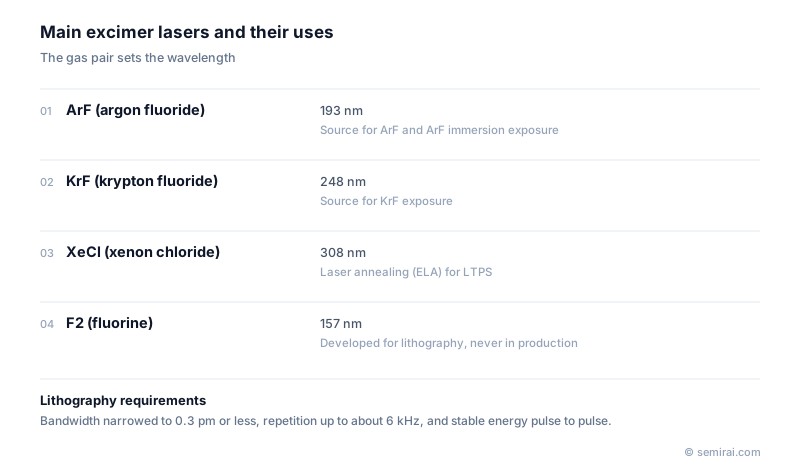
An excimer laser is a gas laser that passes an electric discharge through a mix of a rare gas (argon, krypton or xenon) and a halogen (fluorine or chlorine), and extracts ultraviolet light from molecules that exist only in the excited state. The wavelength is set by the gas pair: 193 nm for ArF, 248 nm for KrF and 308 nm for XeCl.
Also called: ArF laser, KrF laser, XeCl laser
Diagram
Light source for DUV lithography
KrF and ArF excimer lasers are the light sources of deep-ultraviolet (DUV) lithography, including ArF immersion, and still expose many layers of modern chips. Lithography lasers must have their spectral bandwidth narrowed to 0.3 pm or less, pulse thousands of times per second (up to about 6 kHz) and hold pulse energy very stable.
Only a handful of companies make lithography excimer lasers. Gigaphoton of Japan and Cymer, a subsidiary of ASML, are the main suppliers.
Laser annealing and neon supply
Excimer lasers are also used for heat treatment. In excimer laser annealing (ELA), light from a XeCl or similar laser is shaped into a line and scanned across amorphous silicon on glass, melting it so it recrystallises into polysilicon. This is how low-temperature polysilicon (LTPS) thin-film transistors for smartphone OLED displays are made.
Most of the laser gas is neon, used as a buffer gas. Because lithography lasers consume a lot of neon, disruptions to neon supply have affected chip production, and gas recycling systems have been introduced to reduce consumption.
Japanese companies involved
- Gigaphoton, based in Japan, makes KrF and ArF excimer lasers used as light sources in DUV lithography tools, as well as lasers for annealing.
- Gigaphoton · Excimer laser light sources for lithography
FAQ
What does 'excimer' mean?
It is short for 'excited dimer'. Atoms such as argon and fluorine do not normally bond, but after the discharge gives them energy they form a molecule that exists only in the excited state. When it breaks apart it emits an ultraviolet photon. ArF and KrF are strictly exciplexes, but the name excimer is used by convention.
Why did 157 nm F₂ lasers not replace ArF?
F₂ lasers emitting at 157 nm were developed for lithography, but suitable lens materials and resists proved very difficult, since few materials are transparent there. When water immersion let ArF scanners reach higher NA instead, the industry dropped 157 nm and kept ArF until EUV arrived.
Related pages
Sources
Last updated: November 13, 2026