DUV (Deep Ultraviolet)
DUV (deep ultraviolet) is the ultraviolet range with wavelengths of roughly 100-300 nm. In semiconductor lithography the term means the two excimer laser wavelengths in production use, KrF at 248 nm and ArF at 193 nm, as distinct from 13.5 nm EUV. Even after EUV's arrival, DUV tools print most patterned layers in fabs worldwide.
Also called: deep ultraviolet, DUV lithography, KrF, ArF
Diagram
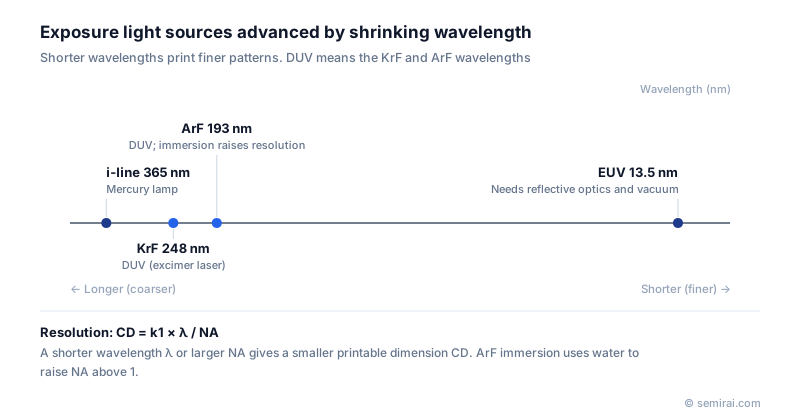
How DUV lithography evolved
Lithography moved from mercury-lamp g-line (436 nm) and i-line (365 nm) to the KrF excimer laser in the 1990s and to the ArF laser around the turn of the century. Each step to a shorter wavelength allowed finer patterns, but also required new lens materials, new resists and new light sources.
The next planned wavelength, 157 nm, was abandoned, and the industry instead raised the numerical aperture of ArF tools by placing water between the lens and wafer. ArF immersion, combined with multi-patterning, extended 193 nm lithography for more than a decade until EUV entered production.
Where DUV is used today
Leading-edge logic and DRAM print only their most critical layers with EUV. The many remaining layers, such as wider metal levels, implant masks and less dense patterns, use ArF immersion, ArF dry or KrF scanners, which are cheaper per exposure and have higher throughput.
Mature-node fabs producing microcontrollers, automotive chips, image sensors, analogue and power devices rely almost entirely on DUV and i-line tools. 3D NAND also uses DUV extensively, because its density comes from stacking layers rather than from the finest lateral patterns.
Japanese companies involved
- Nikon makes ArF immersion, ArF dry and KrF scanners, and Canon makes KrF scanners and i-line steppers.
- Gigaphoton makes KrF and ArF excimer lasers used as light sources in DUV exposure tools.
- Gigaphoton · Excimer laser light sources for lithography
- Nikon · ArF, KrF and i-line lithography systems
- Canon · Lithography steppers and nanoimprint lithography
FAQ
What is the difference between DUV and EUV?
The wavelength. DUV uses 248 nm or 193 nm light that can pass through specially made lenses, in air or water. EUV uses 13.5 nm light, which almost every material absorbs, so it needs vacuum, mirror optics and reflective masks.
Why is DUV still used now that EUV exists?
Not every layer needs the finest resolution. DUV tools cost far less, process more wafers per hour and are already installed in large numbers, so chipmakers use EUV only where it is necessary.
How is DUV light produced?
By excimer lasers, in which a pulsed electrical discharge excites a mixture of a noble gas and fluorine. Krypton fluoride emits at 248 nm and argon fluoride at 193 nm. The laser's bandwidth is narrowed so the lens can focus the light sharply.
Comparisons
Related pages
Sources
Last updated: November 2, 2026