Edge Bead Removal (EBR)
Edge bead removal (EBR), also called edge rinse, is a step after spin coating in which solvent is applied to the outer few millimetres of the wafer to remove resist or other film. It eliminates the edge bead, a ridge of thicker film that forms because liquid driven outward is held at the rim by surface tension.
Also called: edge rinse, edge clean
Diagram
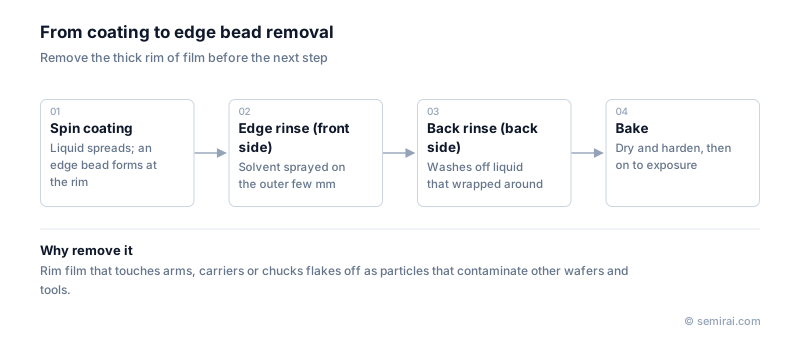
Why the wafer edge is cleaned
Film left on the rim touches robot arms, wafer carriers and the exposure tool's chuck. When it flakes off, it becomes particles that contaminate other wafers and equipment. The thick bead also dries slowly and can crack or peel in later steps.
Coater/developer tracks therefore combine a front-side nozzle that sprays solvent onto the wafer periphery with a back rinse that washes off liquid that has wrapped around to the underside.
EBR, WEE and edge exclusion
Besides solvent removal there is wafer edge exposure (WEE), in which only the rim is exposed to light and the film there is removed during development. The two methods are often used together.
The width removed is tied to edge exclusion, the band at the rim where no chips are placed. Too wide a band reduces the number of usable dies; too narrow a band raises the risk of contamination. In EUV lithography, metal-containing resists make edge and backside cleaning even more important, because metal residues must not spread through the fab.
Japanese companies involved
- Tokyo Electron and SCREEN Holdings build coater/developer tracks with front-side edge rinse and back-rinse nozzles.
- Tokyo Electron (TEL) · Coat/develop, etch and deposition equipment
- SCREEN Holdings · Wafer cleaning, coat/develop and inspection equipment
FAQ
How do edge rinse and wafer edge exposure differ?
Edge rinse dissolves the film with solvent immediately after coating. Wafer edge exposure illuminates only the rim of a positive resist so that the developer removes it later. WEE gives a sharper, more precisely positioned boundary, so many processes use both: solvent for the bulk bead and WEE for a clean edge.
How wide is the removed band?
Typically a few millimetres, set by the fab's edge exclusion rule and the process. The band must be wide enough to clear the thick bead and any film handling tools touch, but every extra millimetre at the rim of a 300 mm wafer costs usable area, so it is kept as narrow as reliability allows.
Related pages
Sources
Last updated: November 2, 2026