Ferroelectric Hafnium Oxide (HZO)
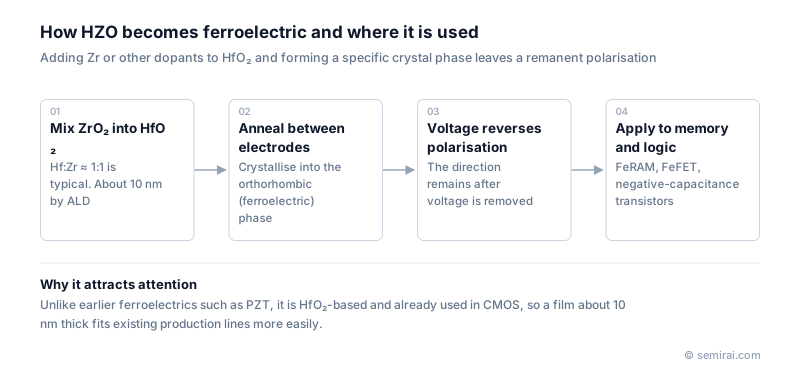
Ferroelectric hafnium oxide is a thin film of HfO₂ doped with elements such as zirconium or silicon that shows ferroelectricity, meaning a polarisation that remains after the voltage is removed and can be reversed. The zirconium-mixed form is called HZO (hafnium zirconium oxide). It was first reported in 2011.
Also called: hafnium zirconium oxide, ferroelectric HfO₂, HfZrO
Diagram
Why HZO attracts attention
Ferroelectric memory (FeRAM) stores a 0 or 1 as the direction of polarisation. Earlier FeRAM used lead zirconate titanate (PZT), which contains lead, does not mix well with CMOS processing and is hard to scale to very thin films.
HZO avoids these problems. Hafnium oxide is already used as the high-k gate dielectric in CMOS, the film can be deposited by atomic layer deposition, and ferroelectricity appears at thicknesses of about 10 nm, thin enough to fit into transistor gates and 3D structures.
How the ferroelectric phase forms
A typical film has a hafnium-to-zirconium ratio near 1:1 and is a few to about ten nanometres thick, sandwiched between electrodes such as TiN. Annealing crystallises it into a non-centrosymmetric orthorhombic phase, which carries the switchable polarisation.
That phase is metastable. Annealing temperature, dopant concentration, film thickness and the electrodes all decide whether the film forms the ferroelectric phase or a non-ferroelectric one, which makes reproducibility a central manufacturing challenge. Endurance, the number of switching cycles before the film degrades, and the tendency of the polarisation window to change with cycling are other open issues.
Device concepts
Applications under study include capacitor-based FeRAM, the ferroelectric field-effect transistor (FeFET), in which polarisation in the gate stack shifts the threshold voltage, and the ferroelectric tunnel junction (FTJ). FeFETs are attractive as embedded non-volatile memory and as analogue synapses for neuromorphic computing, and negative-capacitance transistors use the same material class.
Japanese companies involved
- Tokyo Electron supplies ALD equipment, the method normally used to deposit HZO and other hafnium-based films.
- Tokyo Electron (TEL) · Coat/develop, etch and deposition equipment
FAQ
How is HZO different from ordinary high-k HfO₂?
The chemistry is similar, but the crystal phase differs. Gate-dielectric HfO₂ is used for its permittivity and is usually amorphous or monoclinic. HZO is processed so that it crystallises in the orthorhombic phase, which gives a remanent, switchable polarisation.
Is HZO memory in production?
HZO is mainly in research and development and early product work. Demonstrations of FeRAM and FeFET arrays have been reported, but endurance, variability and retention still have to meet the requirements of each application.
Related pages
Sources
Last updated: November 1, 2026