High-k Dielectric
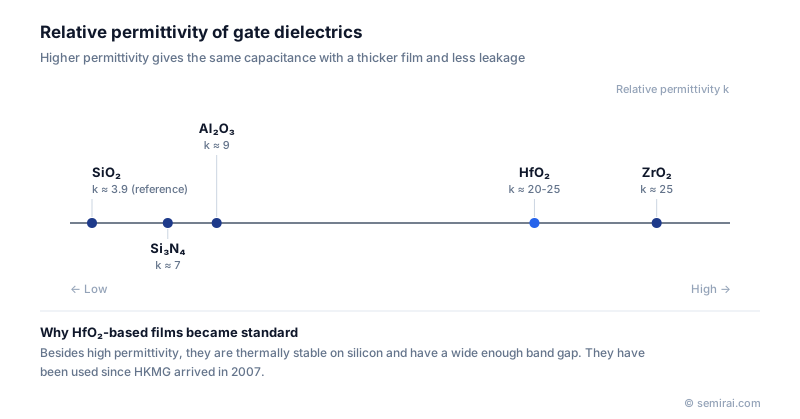
A high-k dielectric is an insulating material whose relative permittivity (k) is well above that of silicon dioxide (k ≈ 3.9), usually above about 10. Hafnium oxide (HfO₂, k ≈ 20-25) is the standard example; combined with a metal gate it entered volume production in Intel's 45 nm process in 2007.
Also called: high-k gate dielectric, high-permittivity dielectric
Diagram
Why gates needed high-k materials
A transistor's gate capacitance grows as the dielectric gets thinner. By the mid-2000s silicon dioxide gate oxides were only around 1 nm thick, and electrons tunnelled straight through them, raising leakage current, power and reliability problems.
A material with higher permittivity gives the same capacitance with a thicker film. Engineers express this as equivalent oxide thickness (EOT): a few nanometres of HfO₂ behave electrically like a much thinner SiO₂ layer while blocking tunnelling far better. HfO₂ also won because it has a wide enough band gap and is thermally stable on silicon.
How high-k films are made and used
High-k gate films are deposited almost exclusively by atomic layer deposition, alternating a hafnium precursor such as HfCl₄ or an organometallic compound with an oxidant such as water or ozone. A very thin silicon oxide or oxynitride interfacial layer is usually kept between the silicon and the HfO₂ to preserve a clean interface.
Polysilicon gate electrodes interact badly with high-k films, pinning the threshold voltage, so high-k is paired with metal gates of TiN, TaN or aluminium-containing alloys that set the threshold voltage of n- and p-type transistors separately. Outside logic gates, stacks such as ZrO₂/Al₂O₃/ZrO₂ serve as the capacitor dielectric in DRAM.
Japanese companies involved
- Kokusai Electric makes batch ALD and deposition systems that are used for thin oxide films, including high-k layers in memory production.
- Kokusai Electric · Batch deposition, diffusion and ALD equipment
FAQ
Why not use a material with an even higher k?
Materials with very high permittivity, such as titanium oxide or strontium titanate, tend to have small band gaps and small energy offsets to silicon, so electrons leak over the barrier instead of through it. Many are also unstable next to silicon. HfO₂-based films are a compromise between permittivity, band gap and stability.
Is high-k the opposite of low-k?
They serve opposite purposes. High-k films are used where you want large capacitance, such as transistor gates and DRAM capacitors. Low-k films are used between interconnect wires, where capacitance only slows signals and wastes power.
Related pages
Sources
Last updated: November 2, 2026