Solder Flux
Solder flux is a material applied before soldering that chemically removes oxide films from metal surfaces and protects them while heating, so that molten solder can wet and spread on them. It is used wherever solder forms a joint in electronics, from flip-chip bumps and BGA solder balls to surface-mount assembly.
Also called: flux, soldering flux
Diagram
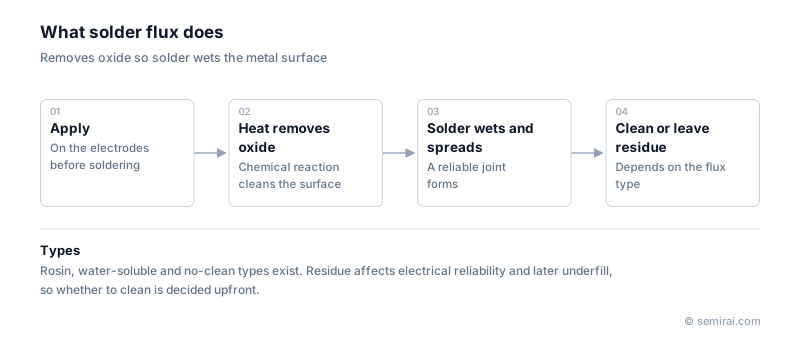
What flux does
Metals such as copper and tin are covered by thin oxide layers that molten solder does not wet. Flux contains activators, usually organic acids or halides, that react with these oxides as the temperature rises. It also forms a layer that keeps air away until the solder melts, and it lowers surface tension so the solder spreads. Without flux, solder would ball up and fail to bond.
In semiconductor packaging, flux is used when solder balls are attached to BGA substrates, when flip-chip bumps are joined to substrates, and when bumps on wafers are reflowed into spheres. It is applied by dipping, printing, spraying or pin transfer, depending on the process.
Types and residues
Fluxes are grouped by their base and how their residue is handled. Rosin fluxes use natural or modified pine resin. Water-soluble fluxes are strongly active but must be washed off, because their residue is corrosive. No-clean fluxes leave only a small, benign residue meant to stay on the part.
In packaging, residue matters a great deal. Left under a flip-chip die, it can cause corrosion or current leakage and can stop underfill from flowing and adhering, creating voids. Flux choice and post-reflow cleaning are therefore designed together with the underfill process. Finer bump pitches call for low-residue fluxes that are still active enough, and the move to lead-free and lower-temperature solders has required new formulations.
Japanese companies involved
- Senju Metal Industry supplies fluxes for semiconductor assembly together with solder alloys and solder balls.
- Senju Metal Industry · Solder, flux and solder balls
FAQ
What is fluxless soldering?
Soldering in which oxides are removed by a reducing gas, such as formic acid vapour or hydrogen, or by plasma, instead of chemical flux. It avoids residues and cleaning, and is used in some fine-pitch flip-chip and power device processes.
Does no-clean flux never need cleaning?
Its residue is designed to be safe on ordinary circuit boards, but in packaging it may still be removed before underfill or molding, because even small residues can affect adhesion and reliability in very narrow gaps.
Related pages
Sources
Last updated: November 13, 2026