Reflow Soldering
Reflow soldering is a method of joining components to a substrate by heating solder that has already been applied, such as solder paste, solder balls or bumps, until it melts and wets both surfaces. A whole board or package passes through a reflow oven, so hundreds or thousands of joints are made at once.
Also called: reflow, mass reflow, reflow oven
Diagram
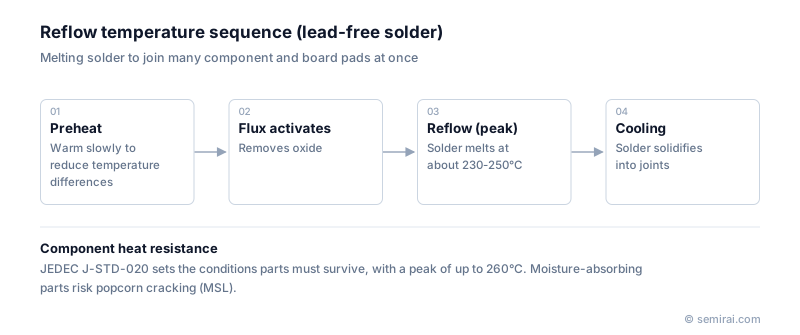
The temperature profile
A reflow oven heats the assembly along a planned temperature profile. In preheat and soak, the temperature rises to roughly 150-200°C and is held for a minute or two, so the flux activates and the whole assembly reaches an even temperature. In the reflow zone, the temperature rises above the solder's melting point. For the common tin-silver-copper (SAC) lead-free alloy, which melts at about 217-220°C, the peak is typically around 230-250°C for a few tens of seconds. The assembly is then cooled so the solder solidifies.
Most ovens heat by forced hot air, and nitrogen atmospheres are used to reduce oxidation. The JEDEC/IPC standard J-STD-020 sets the reflow conditions that components must survive, with peak temperatures of up to 260°C for small lead-free packages, and defines moisture sensitivity levels (MSL) that tell users how long a package may be exposed to air before it must be baked.
Reflow in packaging and typical defects
In the back end, reflow joins solder balls to BGA substrates, joins flip-chip bumps to substrates and reshapes plated wafer bumps into spheres. With flip-chip C4 bumps, the surface tension of molten solder pulls the die into alignment, which is called self-alignment.
Typical defects are voids, bridges between neighbouring joints, head-in-pillow joints where a warped package lifts its ball from the paste so they never merge, and popcorn cracking, where absorbed moisture turns to steam and cracks the package. For bump pitches of a few tens of micrometres, warpage of the whole package becomes a problem, so thermocompression bonding or laser-assisted bonding, which heat locally, are used instead.
Japanese companies involved
- Senju Metal Industry makes reflow ovens as well as solder alloys, solder balls and flux.
- Tamura Corporation · Reflow soldering systems
- Senju Metal Industry · Solder, flux and solder balls
FAQ
Does reflow have another meaning in chip making?
Yes. In front-end processing, heating a borophosphosilicate glass (BPSG) film so that it softens and flows to smooth the surface is also called reflow. It is unrelated to soldering.
How are reflow defects prevented?
By tuning the temperature profile to the solder and components, controlling package warpage, using suitable flux and stencil design, and baking moisture-sensitive packages before assembly so that absorbed water cannot cause popcorn cracking.
Related pages
- Solder Ball
- Solder Flux
- Flip Chip
- BGA (Ball Grid Array)
- Void (Packaging Defect)
- Underfill
- Package Substrate
- BPSG / PSG (Borophosphosilicate Glass)
- Reflow ovens
- Solder materials
- Flip-chip bonders
- Senju Metal Industry SNR-GT-B Series
- Senju Metal Industry SVR-625GT-C
- Tamura Corporation Solder paste for micro bump formation
- Tamura Corporation TNR15 SERIES
Sources
Last updated: November 13, 2026