Standoff
Standoff is the height of the gap between a component and the board it is mounted on. In semiconductor assembly it usually means the distance between the bottom of a package and the surface of the printed circuit board, which is the height of the solder joints. For BGAs and flip chips it is the height of the solder balls or bumps after reflow.
Also called: standoff height, solder joint height
Diagram
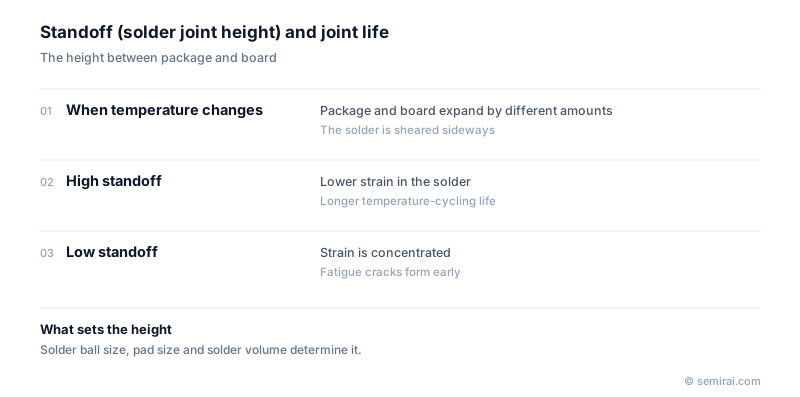
Why standoff controls fatigue life
Silicon, mould compound and a glass-epoxy board expand by different amounts when temperature changes. Each heating and cooling cycle therefore shears the solder joints sideways. For the same sideways displacement, a taller joint experiences less strain, because the movement is spread over a greater height.
A higher standoff thus lengthens temperature-cycling fatigue life, while a standoff that is too low concentrates strain and leads to early cracks. The final height is set by the solder ball size, the pad sizes on package and board, the amount of solder paste and the reflow conditions.
Effects on assembly quality
If the gap is too narrow, underfill resin cannot flow easily beneath the chip, leaving voids, and cleaning fluid has difficulty reaching and draining flux residue. Package warpage or poor coplanarity makes the standoff vary from place to place, causing some joints to stay open and others to bridge.
To secure height, engineers adjust solder volume and pad design, and some packages use copper-core solder balls, whose solid core keeps a minimum gap even when the solder melts.
Japanese companies involved
- IBIDEN and Shinko Electric Industries make package substrates, whose pad and solder resist design is one of the factors that set the final standoff of BGA and flip-chip joints.
- Shinko Electric Industries · FC-BGA package substrates and lead frames
- IBIDEN · IC package substrates (FC-BGA)
FAQ
How is standoff measured?
After reflow, it can be measured on cross-sections or with X-ray and laser profiling systems that compare the height of the package body with the board surface. Designers also estimate it in advance from ball volume and pad geometry.
Does a higher standoff have any drawbacks?
Yes. Taller joints need larger balls or more solder, which limits how fine the pitch can be and raises the risk of bridging between neighbours. The package also sits higher on the board, which matters in thin devices.
Related pages
Sources
Last updated: November 2, 2026