Surface Mount Technology (SMT)
Surface mount technology (SMT) is an assembly method in which electronic components are placed directly onto pads on the surface of a printed circuit board and soldered there. Components designed for it are called surface mount devices (SMDs); semiconductor examples include SOP, QFP, QFN, BGA and CSP. SMT has replaced through-hole insertion as the mainstream method.
Also called: SMT, surface mounting, SMD
Diagram
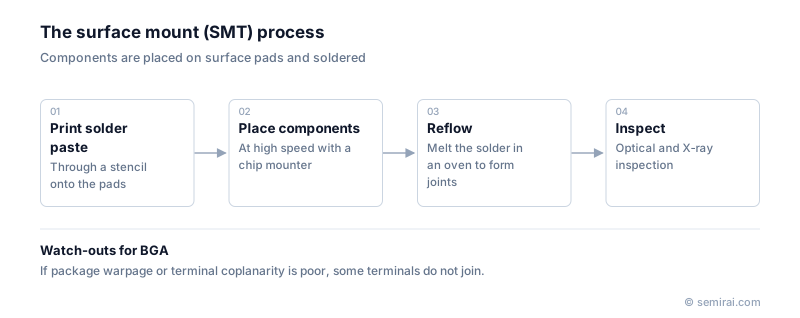
The SMT process
A typical line has four steps. First, solder paste is printed onto the board pads through a metal stencil. Second, a pick-and-place machine (chip mounter) picks up each component with a vacuum nozzle and places it precisely. Third, the whole board passes through a reflow oven that melts the solder and forms the joints. Fourth, automated optical inspection (AOI) and X-ray inspection check joint quality and placement.
Modern mounters place tens of thousands of components per hour, and components can be mounted on both sides of the board.
Benefits and quality challenges
Without holes for leads, both board surfaces are usable and components can be much smaller, which drove the miniaturisation, higher density and automation of electronics.
Packages whose joints are hidden underneath, such as BGAs, cannot be inspected by eye, so X-ray inspection is needed. Package warpage, terminal coplanarity and solder paste volume then decide quality. The move to lead-free solder raised reflow temperatures, making component heat resistance and moisture control more important: moisture absorbed by a package can expand violently during reflow and crack it.
Japanese companies involved
- Japan is home to several major makers of SMT equipment, including Fuji Corporation, Panasonic and Yamaha Motor, which build chip mounters and related line equipment.
- Panasonic Connect · Plasma dicing, dry etching, plasma cleaning and flip chip bonding equipment
FAQ
What is the difference between SMT and through-hole mounting?
Through-hole mounting inserts component leads into drilled holes and solders them on the far side. SMT places components on surface pads with no holes. Through-hole joints are mechanically stronger, so they are still used for heavy parts and connectors, while SMT dominates everywhere else.
Why must some packages be baked before SMT?
Plastic packages absorb moisture from the air. During reflow this moisture turns to vapour and can cause internal delamination or cracks, sometimes called popcorning. Moisture-sensitive packages are shipped in dry packs and baked if their floor-life limit is exceeded.
Related pages
Sources
Last updated: November 13, 2026