Stealth Dicing
Stealth dicing is a wafer dicing method in which a laser beam that passes through the silicon is focused inside the wafer to form a thin modified layer along each street. The wafer is then split into dies by stretching the dicing tape, so the surface is never cut and almost no debris or kerf loss is produced.
Also called: SD, laser stealth dicing, internal modification dicing
Diagram
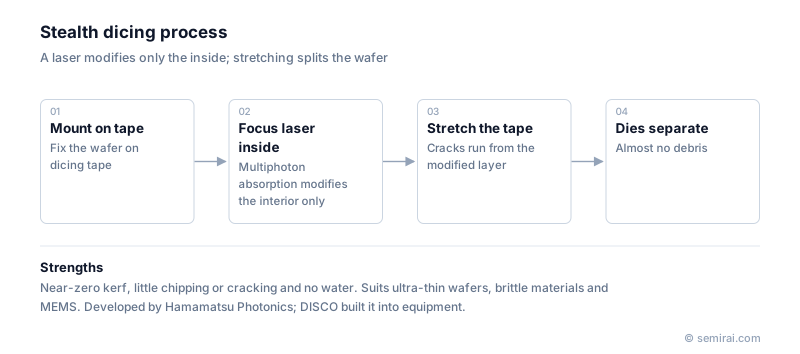
How it works
A wavelength that silicon largely transmits, in the near infrared, is focused to a tiny spot below the surface. Only at the focus is the intensity high enough for nonlinear (multiphoton) absorption, which creates a modified layer with cracks running from it. Thicker wafers receive several passes at different depths. The wafer, mounted on dicing tape, is then expanded; the stress makes the cracks run through the thickness, and the dies separate cleanly.
The method was developed by Hamamatsu Photonics, which supplies the laser engines, and dicing machine makers build them into complete systems.
Advantages and limits
Because nothing is removed, the kerf width is close to zero, so more dies fit on a wafer when the streets can be narrowed. There is little chipping or micro-cracking at the die edges, which keeps die strength high. The process is dry, so no water reaches the device surface. These properties suit very thin memory wafers for multi-die stacks, MEMS devices with fragile surface structures, image sensors and small dies.
Stealth dicing does not suit every wafer. Metal layers, test patterns or some films in the streets can block or scatter the laser, and very thick wafers need many passes. Blade dicing remains cheaper for many products, and laser grooving or plasma dicing are other alternatives.
Japanese companies involved
- Hamamatsu Photonics developed the stealth dicing technique, and DISCO and Tokyo Seimitsu (ACCRETECH) make dicing machines that use it.
- Hamamatsu Photonics · Failure analysis, process monitoring and static elimination equipment
- DISCO · Dicing, grinding and polishing equipment
- Tokyo Seimitsu (ACCRETECH) · Wafer probers, dicing and grinding machines, metrology
FAQ
How is stealth dicing different from blade dicing?
Blade dicing grinds away a groove tens of micrometres wide with a diamond blade and cooling water, which can chip the edges. Stealth dicing cuts nothing from the surface; it weakens the inside of the wafer with a laser and then breaks it, so it is dry and leaves almost no kerf.
Can stealth dicing be combined with wafer thinning?
Yes. In stealth dicing before grinding (SDBG), the modified layer is formed first and the wafer is then ground thin, which splits it into dies during grinding. This is used for very thin memory dies.
Related pages
Sources
Last updated: November 2, 2026