Solder Resist
Solder resist is an insulating protective coating that covers the surface of a printed circuit board or package substrate, with openings only over the pads to be soldered, so that solder does not wet the rest of the wiring. It is also called solder mask, and it gives most boards their green colour.
Also called: solder mask, solder resist ink, photo solder resist
Diagram
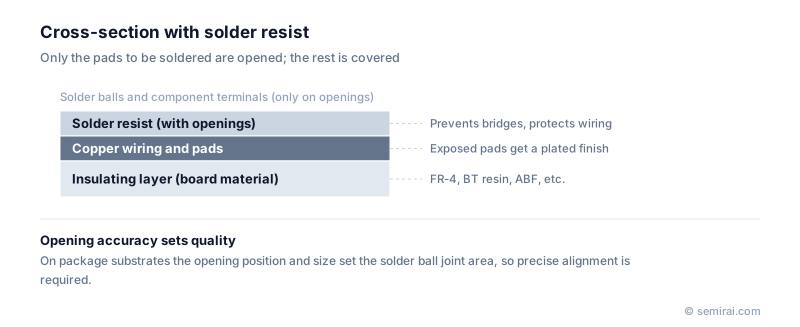
What it does and how it is applied
Solder resist has three jobs. It stops solder from bridging between neighbouring conductors during soldering. It protects the copper from oxidation, moisture and scratches. And it maintains insulation between closely spaced lines.
Most modern resists are photosensitive (photo solder resist). The material is applied as a liquid or laminated as a dry film, exposed through a pattern and developed, much as in photolithography, to open windows over the pads. The exposed pads then receive a surface finish such as nickel-gold plating.
Role in package substrates
On a package substrate, the resist openings directly set the position and size of each solder ball or bump joint, so their position accuracy and thickness uniformity affect joint quality.
There are two pad designs. In SMD (solder mask defined) pads, the resist overlaps the edge of the copper pad, and the opening sets the joint area. In NSMD (non solder mask defined) pads, the opening is larger than the pad, so solder also wraps around the pad sides. They are chosen according to joint strength and how easily traces can be routed between pads.
Japanese companies involved
- IBIDEN and Shinko Electric Industries apply and pattern solder resist on the FC-BGA substrates they produce.
- Taiyo Holdings is a well-known Japanese maker of solder resist inks for printed circuit boards and package substrates.
- IBIDEN · IC package substrates (FC-BGA)
- Shinko Electric Industries · FC-BGA package substrates and lead frames
FAQ
Why are circuit boards usually green?
Because the solder resist is green. Green became a convention that inspection equipment and operators are used to, but black, white, blue and red resists are also made; white is used on LED boards for its reflectivity.
Which is better, SMD or NSMD pads?
Neither in every case. NSMD pads give stronger joints and leave more room for routing traces between pads. SMD pads hold the copper more firmly against peeling and give better control of joint size, so they are often chosen for package-side pads or for drop-shock resistance.
Related pages
Sources
Last updated: November 12, 2026