Thermal Interface Material (TIM)
A thermal interface material (TIM) is a material placed between two parts of a cooling path, such as a chip and a heat spreader or a heat spreader and a heat sink, to improve heat flow between them. Rigid surfaces touch only at a few high points, and the gaps fill with air, which conducts heat poorly; a TIM fills those gaps.
Also called: TIM, TIM1, TIM2, thermal grease, thermal pad
Diagram
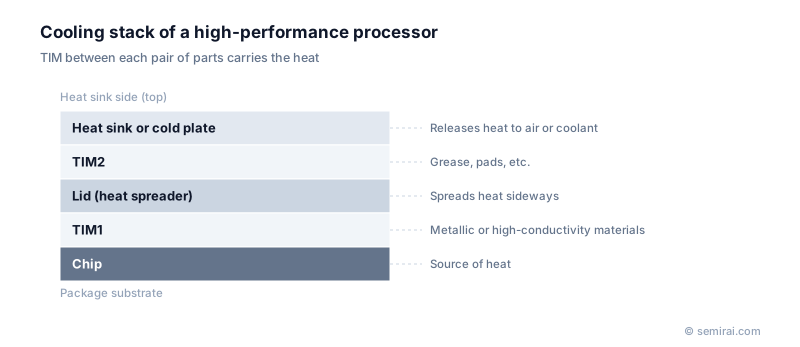
Types of TIM
Common forms include grease, which is a silicone or other oil loaded with thermally conductive particles; soft sheet-like pads; phase-change materials that soften and spread when heated; curing gels; and metallic TIMs such as solder or indium.
High-performance CPUs and GPUs distinguish TIM1, between the chip and its lid (heat spreader), from TIM2, between the lid and the heat sink or cold plate. TIM1 sits closest to the heat source and often uses metallic or other high-conductivity materials. TIM2 more often uses grease or pads, which are easy to apply and rework.
Why TIM matters more for AI chips
AI accelerators can dissipate from several hundred watts to around a kilowatt in one package, so the TIM has become a significant factor in chip temperature.
Beyond thermal conductivity, a good TIM must be applied thin and uniform, and it must not crack or delaminate when chip and lid flex and expand by different amounts. Over years of use it should not dry out or be pumped out by thermal cycling. Liquid metals and carbon-based materials are being developed for the most demanding cases.
Japanese companies involved
- Shin-Etsu Chemical makes silicone thermal greases, pads and gap fillers used as TIMs in electronics.
- Resonac develops materials for thermal management in advanced packages, including thermal interface materials.
- Shin-Etsu Chemical · Silicon wafers, photoresists and photomask blanks
- Resonac · CMP slurries, packaging materials and SiC epitaxial wafers
FAQ
Is a thicker TIM layer better?
No. The TIM conducts heat far worse than metal, so the layer should be as thin as possible while still filling the gaps. Bond-line thickness and uniformity are therefore controlled closely in assembly.
Why do some processors have no lid?
Removing the lid and pressing the heat sink directly on the die eliminates one TIM layer and one interface, lowering thermal resistance. The trade-off is that the bare die is more exposed to mechanical damage during assembly.
Related pages
Sources
Last updated: November 2, 2026