GPU (Graphics Processing Unit)
A GPU (graphics processing unit) is a processor built from thousands of small arithmetic cores that execute the same instruction on many pieces of data in parallel. Designed originally to render 3D graphics, it is very efficient at the matrix and vector arithmetic of deep learning, and has become the main computing device for training and running AI models.
Also called: graphics processor, AI accelerator
Diagram
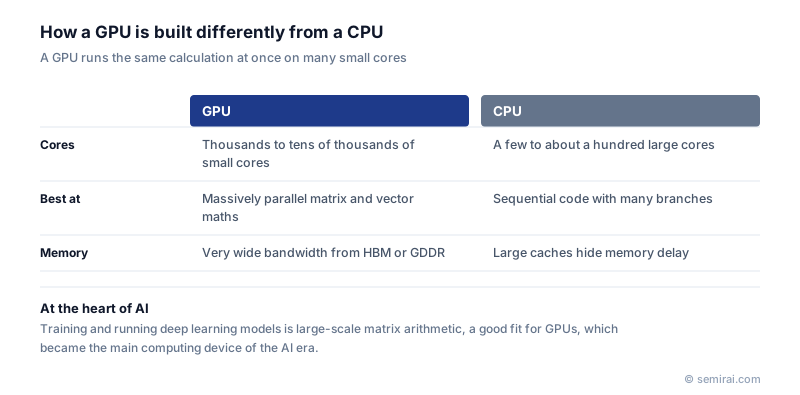
How a GPU differs from a CPU
A CPU has a small number of large cores optimised for running one thread of instructions quickly, with branch prediction and large caches to hide memory latency. A GPU spends its silicon on many simpler cores grouped into units that process wide batches of data together. It is slow on branchy, sequential code but very fast when the same calculation must be repeated millions of times, as in shading pixels or multiplying large matrices.
Data-centre GPUs add dedicated matrix units (tensor cores) for low-precision arithmetic used in neural networks. Programming models such as NVIDIA's CUDA and AMD's ROCm let general software run on the GPU, and the support of deep-learning frameworks for these platforms is a large part of the GPUs' competitive position.
What a GPU needs from manufacturing
Large GPUs are among the biggest dies made, close to the maximum area a lithography scanner can expose in one field, and are built on leading-edge logic processes. Because they are limited by how fast data can be supplied, AI GPUs are placed next to stacks of high-bandwidth memory (HBM) on a silicon interposer or bridge, using 2.5D packaging such as TSMC's CoWoS. The supply of HBM and of this packaging capacity has at times limited how many AI GPUs could be shipped.
Power is the other constraint. A single data-centre GPU can draw several hundred watts or more, which drives demand for efficient power delivery, advanced cooling including direct liquid cooling, and high-performance package substrates.
Japanese companies involved
- IBIDEN and Shinko Electric Industries make FC-BGA package substrates of the kind used under large processors such as GPUs.
- Advantest makes automated test equipment used to test large SoCs, including high-performance processors.
- IBIDEN · IC package substrates (FC-BGA)
- Shinko Electric Industries · FC-BGA package substrates and lead frames
- Advantest · Automated test equipment (ATE) for SoC and memory
FAQ
Who designs and makes GPUs?
NVIDIA, AMD and Intel design discrete GPUs. All three rely on TSMC for many of their leading products, while Intel also uses its own fabs. Mobile GPUs are built into smartphone SoCs by Apple, Qualcomm and Arm licensees.
Is a GPU the same as an NPU or TPU?
No. NPUs and TPUs are accelerators designed only for neural-network arithmetic, giving up the GPU's programmability in exchange for efficiency. Google's TPU and Amazon's Trainium are examples. GPUs remain more flexible, which is why they dominate training of new models.
Why does an AI GPU need HBM?
The cores can process data far faster than ordinary DRAM interfaces can deliver it. HBM stacks DRAM dies with a very wide interface placed millimetres from the GPU, giving several times the bandwidth of GDDR memory at lower energy per bit.
Related pages
Sources
Last updated: November 2, 2026