Helium Leak Test
A helium leak test uses helium gas as a tracer to find where, and how much, gas leaks into or out of vacuum equipment, piping or vessels. It uses a helium leak detector, an instrument with a built-in mass spectrometer that counts only helium. It is widely used after assembling tools, after gas line hook-up and in periodic maintenance.
Also called: helium leak detector, helium mass spectrometer leak detection
Diagram
Why helium
Helium atoms are very small and pass easily through narrow gaps. Helium is inert and non-flammable, so it is safe to spray around equipment. And air contains only about 5 ppm of helium, so any helium the detector sees can be attributed to a leak.
The detector counts only mass 4, which makes it extremely sensitive; the best instruments detect leaks of around 10⁻¹² Pa·m³/s.
Three test methods
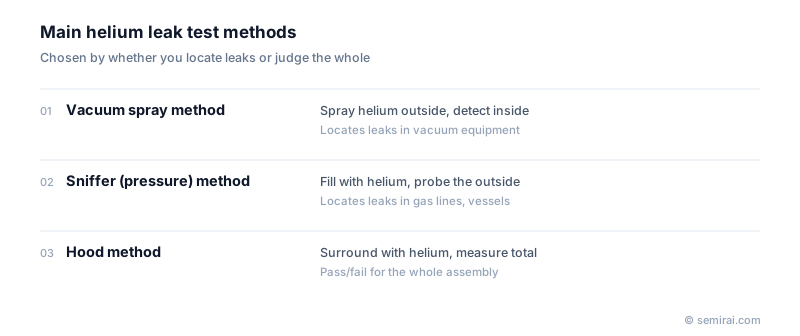
In the vacuum spray method, the evacuated equipment is connected to the detector and helium is sprayed from outside onto suspect points; a signal shows where helium is entering. In the sniffer, or pressurisation, method, the part is filled with helium and a probe is moved along its outside to pick up escaping gas. In the hood method, the whole object is enclosed in a bag or box filled with helium to measure its total leak rate.
The spray method suits locating leaks in vacuum systems, the sniffer method suits gas lines and vessels, and the hood method suits pass/fail judgement of a complete assembly.
Japanese companies involved
- ULVAC makes helium leak detectors used in semiconductor equipment assembly and maintenance.
- ULVAC · Vacuum deposition (sputtering) equipment and vacuum pumps
FAQ
Why not use hydrogen, which is also small?
Hydrogen is also small and is used in some sniffer tests as a diluted mixture with nitrogen, but it is flammable. Helium is inert, safe at any concentration, and has a very low background in air, so it remains the standard tracer for sensitive vacuum leak testing.
When should I use the spray method rather than the sniffer method?
Use spray when the object can be evacuated, as with vacuum chambers; it is the most sensitive way to pinpoint a leak. Use the sniffer when the object is normally pressurised, such as gas piping or cylinders, because it detects helium escaping outward.
Related pages
Sources
Last updated: November 2, 2026