Lift Pin
A lift pin is a thin rod inside a process chamber that pushes a wafer up from below, off an electrostatic chuck or heater stage, and lowers it gently back down. Usually three pins move through small holes in the stage, lifting the wafer so that the transfer robot's end effector can slide underneath it.
Also called: wafer lift pin
Diagram
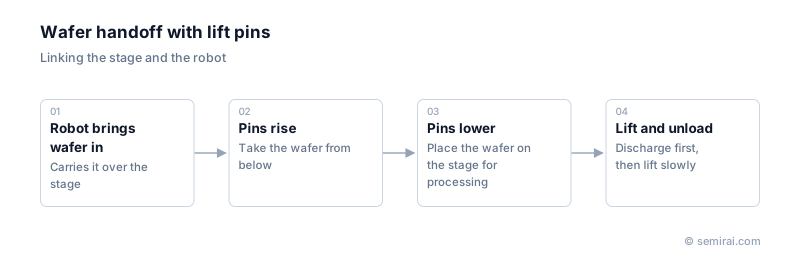
How the handoff works
The robot carries the wafer over the stage and the lift pins rise to take it. Once the robot hand withdraws, the pins lower and place the wafer on the stage. After processing, the sequence runs in reverse: the pins raise the wafer and the robot takes it away.
Because the pins must move up and down without breaking the vacuum, they are driven by a mechanism sealed with bellows.
Why a small part causes big problems
If charge remains on the wafer after processing on an electrostatic chuck, raising the pins can make the wafer jump, slide or even crack. Discharging the wafer (dechucking) and controlling how fast the pins rise are therefore important. Contact with the pin tips can scratch the wafer backside or create particles, and the holes in the stage can disturb temperature or the plasma above them, leaving non-uniform spots.
Pins are made of materials that withstand plasma and heat, such as ceramics, quartz and sapphire.
Japanese companies involved
- Kyocera makes ceramic lift pins among its fine ceramic components for semiconductor equipment.
- NTK Ceratec makes electrostatic chucks and ceramic heaters, the stages through which lift pins move, and Shin-Etsu Quartz Products makes high-purity quartz parts for process chambers.
- Kyocera · Package substrates and ceramic components
- NTK Ceratec · Ceramic heaters, electrostatic chucks and susceptors
- Ferrotec · Quartz, silicon and ceramic parts for equipment; thermoelectric modules
- Shin-Etsu Quartz Products · High-purity quartz glass parts and crucibles
FAQ
Why does a wafer jump when the lift pins rise?
An electrostatic chuck holds the wafer with electrical force. Even after the voltage is switched off, residual charge can remain on the wafer or chuck surface. If the pins lift the wafer while that force remains, it releases suddenly and jumps or shifts. A discharge step and a slow initial lift prevent this.
What materials are lift pins made of?
Because they face plasma, high temperature and corrosive gases, lift pins are made of ceramics such as alumina, or quartz and sapphire. They touch the wafer backside, so the material must also shed few particles and must not cause metal contamination.
Related pages
Sources
Last updated: November 2, 2026