Hook-up (Tool Utility Connection)
Hook-up is the construction work, done after a process tool is set in place, that connects it to the fab's utilities through piping and wiring: process gases, chemicals, ultrapure water, process cooling water, nitrogen and clean dry air, vacuum, exhaust, electrical power and data lines. A tool cannot run until hook-up is complete.
Also called: hookup, tool hook-up, tool install
Diagram
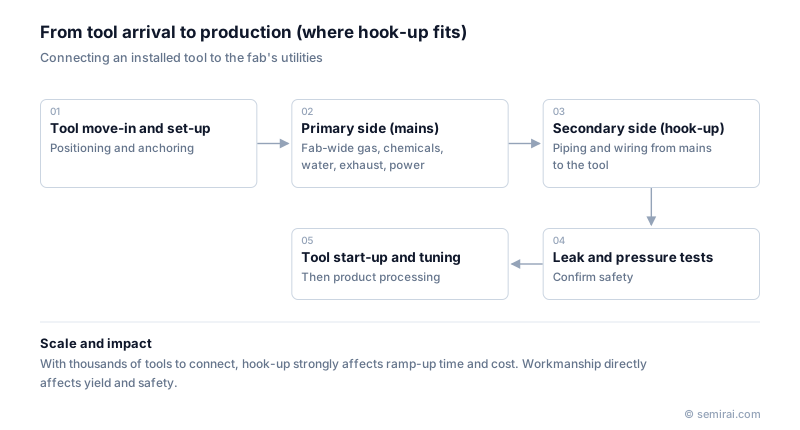
Primary and secondary hook-up
Work is usually split into two parts. The primary side is the main distribution network of pipes, ducts and cables that runs through the fab, built alongside the building. The secondary side, often what people mean by hook-up, branches from those mains to the connection points on each tool and is done after the tool is installed.
Gas lines use stainless steel tubing with electropolished inner surfaces joined by orbital welding. After installation the lines are leak-tested and purged to remove moisture and particles. For toxic or flammable gases the work includes gas detectors, emergency shut-off valves and connections to abatement units.
Why hook-up matters
A large fab installs hundreds to thousands of tools, so hook-up is a large part of the time and cost of bringing a fab into production, and it is carried out by specialist contractors. Poor work leaves particles, metals or moisture in the lines that later reduce yield, and a leak of hazardous gas can cause a serious accident.
Materials, workmanship and inspection are therefore governed by strict specifications. Tool makers, the fab owner and contractors agree the exact specification of each point of connection before work begins.
Japanese companies involved
- Taiyo Nippon Sanso supplies specialty gases and gas supply systems for fabs.
- Fujikin makes valves, fittings and integrated gas systems used in tool gas connections.
- Shinryo Corporation · Precision cleaning of equipment parts and silicon wafer reclaim
- Taiyo Nippon Sanso · Specialty gases, gas supply systems and MOCVD equipment
- Fujikin · Gas flow controllers and integrated gas systems
FAQ
What comes after hook-up?
After leak and pressure tests, the tool is powered up and checked by the tool maker, then the process team runs qualification wafers and tunes recipes until results meet specification. Only then is the tool released for production.
Why are gas lines electropolished?
Electropolishing makes the inner surface of stainless steel tubing very smooth and forms a stable passive layer. This reduces the area that can trap moisture and particles and lowers the release of metals into high-purity gas.
Related pages
Sources
Fab infrastructure and equipment parts terms
Last updated: November 2, 2026