Leak Rate
Leak rate is the amount of gas that leaks per second into a vacuum chamber or piping through joints, valves or welds. It is expressed as pressure times volume per time, such as Pa·m³/s, mbar·L/s or atm·cc/s. Leaks keep the pressure from dropping and let oxygen and moisture into the process, degrading film quality and creating particles.
Also called: leakage rate, rate of rise
Diagram
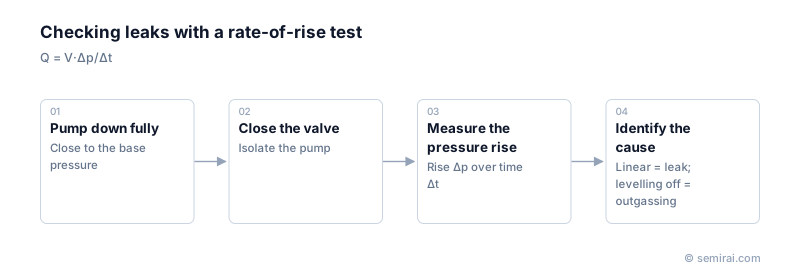
The rate-of-rise test
A simple way to check a whole system is the rate-of-rise, or build-up, test. The chamber is pumped down, then the valve to the pump is closed and the pressure rise is measured over time. With chamber volume V and pressure rise Δp in time Δt, the combined leak and outgassing load is Q = V·Δp/Δt.
The shape of the curve tells the two apart. A pressure that keeps rising in a straight line points to a leak; a rise that gradually slows and levels off points mainly to outgassing.
Finding and specifying leaks
To locate a leak and measure very small ones, engineers use a helium leak detector. The most sensitive instruments detect leaks of around 10⁻¹² Pa·m³/s.
Semiconductor tools and gas lines handle toxic and flammable gases, so systems must be confirmed to meet a specified leak rate before they are put into service, and again after maintenance.
Leak specifications are usually given as a maximum allowed rate for the whole assembly, and the required level depends on the use. A process chamber that must hold high vacuum, or a line carrying toxic gas, is held to a much tighter limit than a simple rough-vacuum enclosure.
Japanese companies involved
- ULVAC makes helium leak detectors used to test vacuum equipment and gas systems.
- ULVAC · Vacuum deposition (sputtering) equipment and vacuum pumps
FAQ
How do you tell a leak from outgassing?
Isolate the pump and watch the pressure. A leak admits gas from the atmosphere at a constant rate, so the pressure rises almost linearly. Outgassing slows as the pressure rises and the walls give up their gas, so the curve flattens and levels off.
How do leak rate units convert?
1 Pa·m³/s equals 10 mbar·L/s and about 9.87 atm·cc/s. So 1 × 10⁻⁹ Pa·m³/s is 1 × 10⁻⁸ mbar·L/s. Tool and detector makers use different units, so convert carefully before comparing specifications.
Related pages
Sources
Last updated: November 2, 2026