Ion Pump (Sputter Ion Pump)
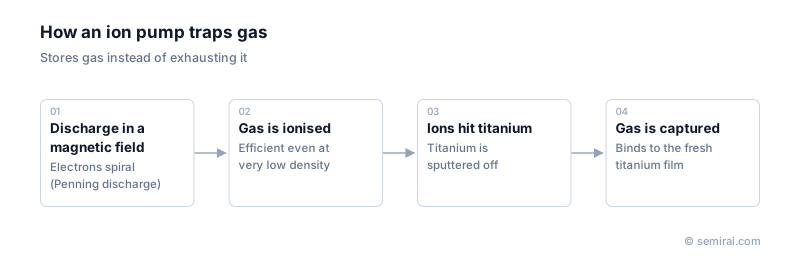
An ion pump, or sputter ion pump, is a vacuum pump that ionises gas molecules in a discharge inside a magnetic field and drives the ions into titanium electrodes. The gas is trapped in the electrode surface and in titanium films sputtered onto the walls. It is a capture pump that stores gas rather than exhausting it, and it is used to produce ultra-high vacuum.
Also called: sputter ion pump, SIP
Diagram
How it works
A voltage of several kilovolts between the electrodes and a strong permanent magnet make electrons spiral over long paths, so even a sparse gas is ionised efficiently. This is called a Penning discharge.
When ions strike the titanium cathode, they sputter titanium onto the surrounding surfaces. The fresh, reactive titanium film binds gases such as oxygen and nitrogen. Chemically inert gases such as argon are hard to pump, so some designs use modified electrode structures to handle them.
Strengths and how it is used
With no moving parts, no vibration, no noise and no oil, an ion pump can hold a very clean ultra-high vacuum for long periods. Its discharge current is roughly proportional to pressure, so it also works as a pressure gauge.
It cannot run at high pressure, so the system is first pumped down with a turbomolecular pump or similar before the ion pump is started. Ion pumps are used in electron microscope guns, molecular beam epitaxy, surface analysis instruments and particle accelerators.
Japanese companies involved
- ULVAC makes sputter ion pumps for ultra-high vacuum systems.
- ULVAC · Vacuum deposition (sputtering) equipment and vacuum pumps
FAQ
Why are ion pumps suited to ultra-high vacuum?
They capture gas inside the pump instead of exhausting it, so nothing flows back from an outlet, and they use no oil and no moving parts, so there is no contamination or vibration. Once the system reaches high vacuum, an ion pump needs only electrical power to keep a clean ultra-high vacuum for a long time.
Which gases are hard for an ion pump to pump?
Inert gases such as argon and helium do not bond with titanium, so they are captured poorly. Pumping a lot of argon can make the pump unstable, releasing gas it had already buried. Noble-gas designs with different electrode materials or shapes are used for these loads.
Related pages
Sources
Fab infrastructure and equipment parts terms
Last updated: November 1, 2026