Vacuum
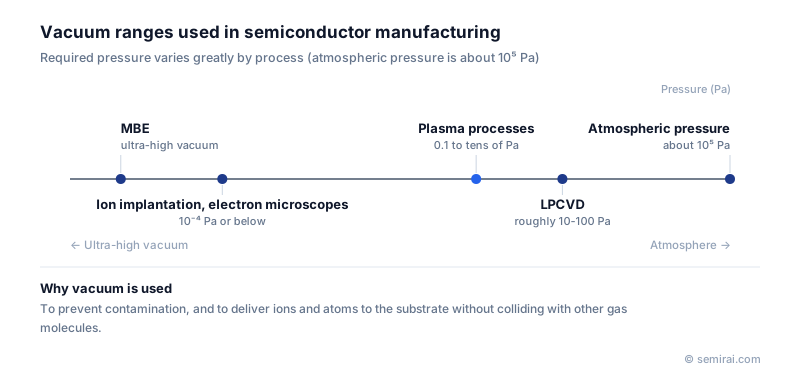
Vacuum is the state of a space filled with gas at a pressure below atmospheric pressure, not the total absence of molecules. In semiconductor manufacturing, most deposition, dry etching, ion implantation, EUV exposure and electron-beam metrology take place in vacuum chambers, at pressures from tens of pascals for plasma processes down to 10⁻⁴ Pa or lower for ion beamlines and electron microscopes.
Also called: vacuum pressure, high vacuum
Diagram
Pressure ranges and units
The Japanese standard JIS Z 8126-1, like the international vocabulary it follows, divides vacuum by pressure: low vacuum from atmospheric pressure (about 101 kPa) down to 100 Pa, medium vacuum from 100 Pa to 0.1 Pa, high vacuum from 0.1 Pa to 10⁻⁵ Pa, and ultra-high vacuum below 10⁻⁵ Pa. The SI unit is the pascal, but equipment engineers also use the torr (1 Torr ≈ 133 Pa) and the millibar (1 mbar = 100 Pa). A 'higher' vacuum means a lower pressure, which is a frequent source of confusion.
What changes with pressure is how far a molecule travels before hitting another, the mean free path. For room-temperature air it is about 7 mm at 1 Pa and about 70 m at 10⁻⁴ Pa. Once the mean free path is longer than the chamber, molecules fly from wall to wall without colliding, and gas flow, heat transfer and plasma behaviour all change.
Why chip processes need vacuum
There are three main reasons. First, removing air keeps oxygen, moisture and particles away from the wafer, preventing contamination and unwanted oxidation. Second, sputtered atoms, ions and electron beams must reach the wafer without being scattered by gas molecules; an ion implanter beamline or a scanning electron microscope therefore needs high vacuum. Third, plasma can be sustained stably only at reduced pressure, typically from about 0.1 Pa to several tens of pascals in etch and plasma CVD chambers.
Each process works in its own range. Low-pressure CVD furnaces run at roughly tens of pascals, while molecular beam epitaxy needs ultra-high vacuum to keep growing surfaces clean. EUV light is absorbed strongly by air, so EUV scanners keep the optical path in vacuum with a small amount of hydrogen gas.
How vacuum is made and measured
A dry pump first evacuates the chamber from atmosphere (roughing); a turbo-molecular pump or cryopump then takes it to high vacuum. No single gauge covers the whole range, so tools combine Pirani gauges near atmosphere, capacitance manometers for accurate process-pressure control, and ionisation gauges for high vacuum. Wafers enter through a load lock, a small chamber pumped down and vented on its own, so the process chamber never has to return to atmosphere.
Japanese companies involved
- ULVAC makes vacuum pumps, gauges and sputtering and other vacuum deposition equipment, and its group company ULVAC Cryogenics makes cryopumps.
- Ebara makes dry vacuum pumps used to evacuate process chambers and load locks in fabs.
- Mirapro makes bellows, vacuum piping and other vacuum components for semiconductor equipment.
- ULVAC Cryogenics · Cryopumps
- ULVAC · Vacuum deposition (sputtering) equipment and vacuum pumps
- Ebara · CMP systems, dry vacuum pumps and exhaust treatment
- Mirapro · Bellows, vacuum piping and vacuum components
FAQ
Is a vacuum completely empty?
No. Even at 1 Pa, a cubic centimetre still holds about 2.4×10¹⁴ gas molecules, and at 10⁻⁵ Pa it holds billions. A perfect vacuum with no molecules at all cannot be achieved; engineers specify the pressure, and sometimes the residual gas composition, instead.
Why do tools use load locks instead of venting the process chamber?
Pumping a large chamber from atmosphere takes time, and every exposure to air lets water vapour adsorb on the walls, which then slowly outgasses and degrades the process. A load lock isolates this cycle to a small volume, keeping the process chamber clean, dry and stable and raising throughput.
Related pages
Sources
Last updated: November 2, 2026