Ionization Gauge
An ionisation gauge is a vacuum gauge that ionises the residual gas molecules in a vacuum by electron impact and determines pressure from the resulting ion current. Because the number of ions is roughly proportional to the number of molecules, it can measure very low pressures and is used from high to ultra-high vacuum. Hot cathode and cold cathode types differ in how they produce electrons.
Also called: ionisation gauge, ion gauge, Bayard-Alpert gauge, cold cathode gauge
Diagram
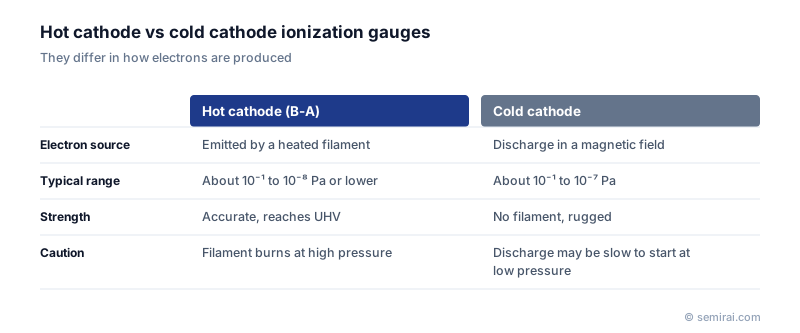
Hot cathode and cold cathode
The best-known hot cathode design is the Bayard-Alpert (B-A) gauge. A heated filament emits electrons, and a thin ion collector wire sits at the centre of a grid. The thin collector reduces the error caused by soft X-rays, extending the range down to around 10⁻⁸ Pa or lower.
A cold cathode gauge uses a magnetic field to make electrons spiral over long paths and sustain a discharge. It has no filament, so it is rugged and is less easily damaged by exposure to higher pressure.
Practical points
Readings depend on the gas, because each gas ionises with a different efficiency. Gauges are calibrated for nitrogen, and other gases need a correction factor.
Switching on a hot filament at high pressure can burn it out, so operators first confirm with a Pirani gauge that the pressure is low enough. For this reason combination gauges that house both sensors in one unit are common.
Japanese companies involved
- ULVAC makes hot cathode ionisation gauges, and Canon ANELVA also makes vacuum gauges as part of its vacuum equipment business.
- ULVAC · Vacuum deposition (sputtering) equipment and vacuum pumps
- Canon ANELVA · Sputtering and vacuum deposition equipment
FAQ
What are the pros and cons of hot and cold cathode gauges?
Hot cathode gauges, such as the Bayard-Alpert type, are more accurate and reach ultra-high vacuum, but the filament can burn out if switched on at high pressure. Cold cathode gauges have no filament and are robust, but the discharge can be slow to start at very low pressure.
Why can an ionisation gauge not be used near atmospheric pressure?
At high pressure the proportional relationship between ion current and pressure breaks down because there is too much gas, and in a hot cathode gauge the filament oxidises and burns out. A Pirani gauge is used to confirm the pressure is low enough before the ionisation gauge is turned on.
Related pages
Sources
Fab infrastructure and equipment parts terms
Last updated: November 1, 2026