Ion Exchange Resin
Ion exchange resin is a material in the form of small beads that removes ions dissolved in water, such as sodium, calcium, chloride and sulphate, by exchanging them for hydrogen ions (H⁺) or hydroxide ions (OH⁻) that it carries. It is one of the core materials in systems that make the ultrapure water used in semiconductor fabs.
Also called: ion exchanger, mixed-bed resin
Diagram
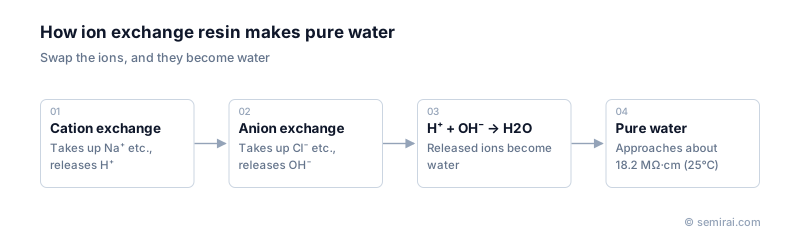
How it purifies water
Cation exchange resin captures positive ions such as sodium and releases H⁺ in their place. Anion exchange resin captures negative ions such as chloride and releases OH⁻. The released H⁺ and OH⁻ combine to form water (H2O).
Passing water through a mixed bed of both resins therefore leaves almost no ions. Pure water has a theoretical resistivity of about 18.2 MΩ·cm at 25°C, and ultrapure water is controlled to stay close to this value.
Regeneration and polishing
As resin keeps capturing ions, it eventually cannot exchange any more. It is then regenerated by flushing with hydrochloric acid and sodium hydroxide, or replaced.
In an ultrapure water system, reverse osmosis membranes and other steps first remove most impurities. Ion exchange resin then removes the remaining ions, and near the point of use a final polisher, high-purity resin used once and not regenerated, finishes the water.
Japanese companies involved
- Organo, Kurita Water Industries and Nomura Micro Science build the ultrapure water systems for semiconductor fabs in which ion exchange resins are a core stage.
- Organo · Ultrapure water systems, water recycling and functional water
- Kurita Water Industries · Ultrapure water systems and wastewater treatment
- Nomura Micro Science · Ultrapure water systems
FAQ
What is a mixed bed?
A mixed bed is a vessel filled with cation and anion exchange resins blended evenly. As water flows through, cation and anion exchange repeat many times, so far fewer ions remain than when the two resins sit in separate vessels. Mixed beds are used for final polishing of ultrapure water.
Why is the resistivity of ultrapure water 18.2 MΩ·cm?
Even perfectly pure water conducts slightly, because a tiny fraction of water molecules split into H⁺ and OH⁻. That alone sets the theoretical upper limit of about 18.2 MΩ·cm at 25°C. Resistivity meters monitor ultrapure water continuously against this limit.
Related pages
Sources
Last updated: November 1, 2026