Ionizer (Static Eliminator)
An ionizer, or static eliminator, is a device that generates positive and negative ions in the air and neutralises static charge on surfaces with ions of the opposite polarity. Cleanrooms are kept at low humidity, so charge builds up easily. Static attracts dust and can destroy devices through electrostatic discharge (ESD), so static elimination is essential.
Also called: ioniser, static eliminator, static neutraliser
Diagram
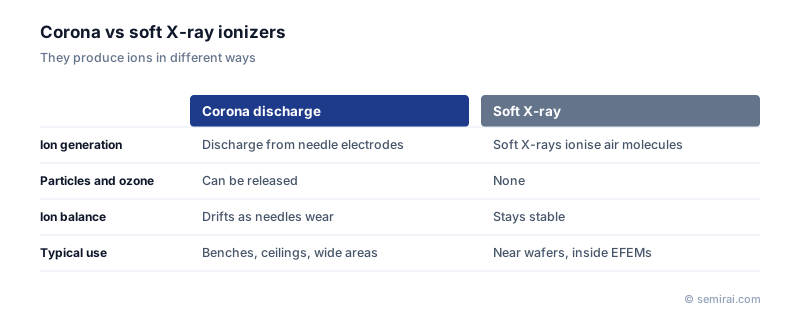
Corona discharge and soft X-ray types
The common type applies a high voltage to needle electrodes to create a corona discharge that produces ions. Variants include AC, DC and pulsed DC designs, which differ in how the voltage is applied.
The other type irradiates the air with soft X-rays, which ionise molecules directly. It uses no discharge, so it produces no particles from electrodes and no ozone, and can be used right next to wafers. The X-ray source must be shielded so it does not reach people.
Ion balance and maintenance
If the amounts of positive and negative ions become unbalanced, an ionizer can charge objects instead of neutralising them. Corona needles also wear and collect dirt over time, which reduces performance and can shed particles.
Ionizers are therefore checked regularly with a charged plate monitor, which measures how quickly a charged metal plate discharges (decay time) and what voltage the plate settles at (ion balance).
Japanese companies involved
- Shishido Electrostatic makes ionizers for static elimination, and Hamamatsu Photonics makes soft X-ray ionizers.
- Keyence and SMC also offer ionizers for production lines.
- Shishido Electrostatic · Ionizers (static elimination)
- Hamamatsu Photonics · Failure analysis, process monitoring and static elimination equipment
FAQ
How do corona and soft X-ray ionizers differ?
Corona ionizers create ions by discharge from needle electrodes. They are inexpensive and cover wide areas, but the needles can release particles and ozone. Soft X-ray ionizers ionise air molecules directly, release no particles or ozone and keep a stable ion balance, so they are used near wafers and in enclosed spaces such as EFEMs.
What is ion balance?
Ion balance is the balance between the positive and negative ions an ionizer produces. If it drifts, the excess polarity charges the objects it is meant to neutralise. It is checked with a charged plate monitor by measuring the voltage a floating metal plate reaches under the ionizer.
Related pages
Sources
Fab infrastructure and equipment parts terms
Last updated: November 12, 2026