Interplanar Spacing (d-spacing)
Interplanar spacing is the distance d between neighbouring parallel planes of atoms with the same orientation in a crystal. The orientation of the planes is written with Miller indices (hkl), and the spacing follows from those indices and the lattice constant. Through Bragg's law it fixes the diffraction angle, making it the most basic quantity in X-ray crystal analysis.
Also called: lattice plane spacing, d-spacing, d-value
Diagram
How to calculate it
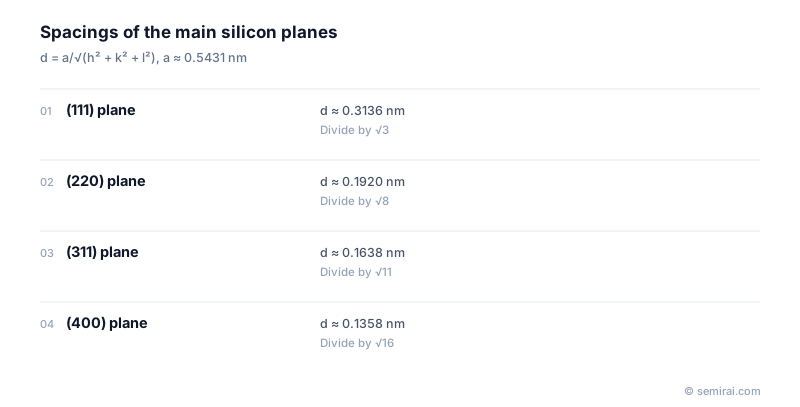
For a cubic crystal with lattice constant a, the spacing is d = a / √(h² + k² + l²). Silicon has a lattice constant of about 0.5431 nm, so the (111) spacing is 0.5431 / √3, or about 0.3136 nm. The larger the Miller indices, the more closely the planes are packed.
Other crystal systems need other formulas. For hexagonal crystals such as GaN, the spacing depends on both lattice constants, a and c. In every case, Bragg's law, 2d sin θ = nλ, links the spacing to the angle θ at which X-rays of wavelength λ are diffracted.
How it is used in semiconductor work
When a crystal is strained, its interplanar spacing changes slightly, and the X-ray diffraction peak shifts. High-resolution X-ray diffraction (HRXRD) measures these shifts very precisely. For a SiGe film grown on silicon, the measured spacings give both the germanium fraction and how much the film is strained or relaxed. The same approach is used for compound semiconductor epitaxial layers.
The lattice fringes visible in high-resolution transmission electron microscope images also correspond to interplanar spacings, so they can be used to identify phases and orientations in very small regions.
Japanese companies involved
- Rigaku makes X-ray diffraction and X-ray metrology systems used to measure lattice spacing, strain and composition in semiconductor films.
- Rigaku · X-ray metrology and thermal analysis
FAQ
What are the spacings of the main silicon planes?
From a lattice constant of 0.5431 nm: about 0.3136 nm for (111), 0.1920 nm for (220) and 0.1358 nm for (400). In the diamond structure some planes, such as (100), (110) and (200), give no diffraction because waves scattered from the atoms cancel out, so those peaks do not appear in standard X-ray patterns.
How do Miller indices affect the spacing?
As the cubic formula shows, the spacing shrinks as the sum of the squares of the indices grows. Closer-spaced planes diffract at larger angles, so high-index reflections appear further out in a diffraction pattern and are more sensitive to small strains.
Related pages
Sources
Last updated: November 12, 2026