Bragg's Law
Bragg's law gives the condition under which X-rays reflected from parallel planes of atoms in a crystal reinforce each other: nλ = 2d sin θ. Here λ is the wavelength, d the spacing between planes, θ the angle between beam and planes, and n an integer. William Henry Bragg and William Lawrence Bragg derived it in 1913, founding X-ray crystallography.
Also called: Bragg condition, Bragg equation
Diagram
Where the equation comes from
A ray reflected from one plane travels a distance 2d sin θ further than a ray reflected from the plane above it. When that extra path equals a whole number of wavelengths, the reflected waves are in phase and add up to a strong diffracted beam. At other angles they cancel, so a crystal reflects strongly only at specific angles set by its plane spacings.
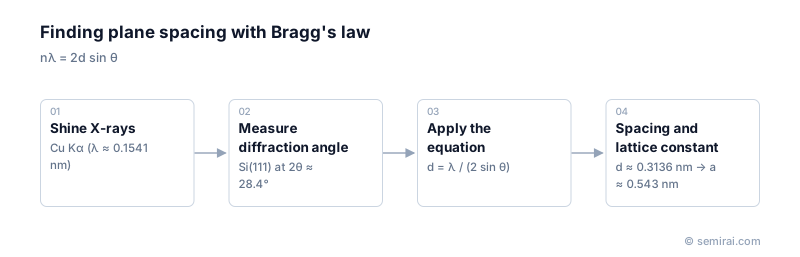
A worked example: laboratory diffractometers commonly use copper Kα X-rays with a wavelength of about 0.1541 nm. The silicon (111) planes are about 0.3136 nm apart, so the first diffraction peak appears at 2θ ≈ 28.4°. The (400) reflection appears at 2θ ≈ 69.1°. Working backwards from a measured angle gives d, and from it the lattice constant of silicon, about 0.543 nm.
Uses in semiconductors
Because diffraction angles give plane spacings, Bragg's law underlies phase identification, lattice constant and strain measurement, and the composition analysis of epitaxial layers such as SiGe, where a slightly different spacing shifts the peak.
The same principle applies to light. A distributed Bragg reflector (DBR), a stack of thin layers with alternating refractive index, reflects a chosen wavelength strongly and is used in vertical-cavity surface-emitting lasers (VCSELs). The molybdenum-silicon multilayer mirrors and mask blanks of EUV lithography are Bragg reflectors for 13.5 nm light.
Japanese companies involved
- Rigaku makes X-ray diffractometers that apply Bragg's law to measure crystal structure, strain and composition in wafers and thin films.
- Rigaku · X-ray metrology and thermal analysis
FAQ
Why must the wavelength be similar to the atomic spacing?
Since sin θ cannot exceed 1, diffraction needs λ ≤ 2d. Visible light, with wavelengths hundreds of times longer than atomic spacings, cannot satisfy the condition, while X-rays of around 0.1 nm can. Electrons and neutrons with similar wavelengths also diffract and are used in the same way.
What does the integer n mean?
It is the order of reflection: n = 1 means a path difference of one wavelength, n = 2 two wavelengths, and so on. In practice higher orders are usually described as first-order reflections from planes with smaller spacing, which is why reflections are labelled such as (111) and (222).
Related pages
Sources
Last updated: November 12, 2026