Nitrogen Trifluoride (NF3)
Nitrogen trifluoride (NF3) is a colourless gas of one nitrogen atom bonded to three fluorine atoms. In semiconductor and display manufacturing it is used mainly to clean films deposited on the inside of CVD chambers. Plasma breaks NF3 down into reactive fluorine atoms, which turn silicon, oxide and nitride deposits into gases that can be pumped away.
Also called: NF3
Diagram
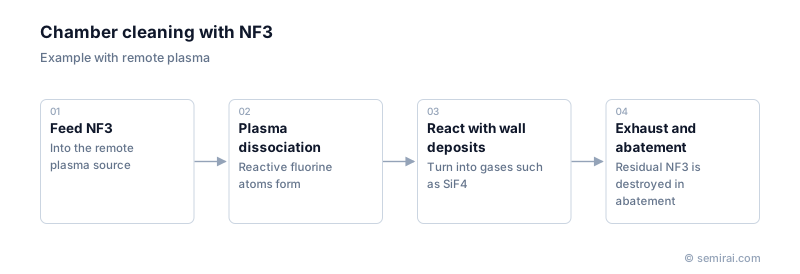
Remote plasma cleaning
NF3 is often used with remote plasma cleaning. The plasma is created in a separate source, and only the fluorine atoms flow into the process chamber. This dissociates most of the gas and avoids exposing chamber parts to ion bombardment, so the cleaning is efficient and gentle on the hardware.
Chamber cleaning used to rely mainly on perfluorocarbons such as C2F6 and CF4. Because NF3 is used up more completely, switching to it reduced both gas consumption and greenhouse gas emissions. Large CVD tools for LCD panels and solar cells also use NF3 in large quantities.
Climate impact and safety
NF3 is a strong greenhouse gas. Its 100-year global warming potential is about 16,000 times that of carbon dioxide in the IPCC Fifth Assessment Report, and it stays in the atmosphere for centuries. It was added to the gases covered under the Kyoto Protocol from the second commitment period. Fabs destroy any unused NF3 in abatement systems.
NF3 is fairly stable at room temperature, but it is a strong oxidiser and reacts violently with metals and organic materials at high temperature, so it must be handled with care.
Japanese companies involved
- Kanto Denka Kogyo produces NF3 and other fluorine-based specialty gases for semiconductor and display manufacturing.
- Taiyo Nippon Sanso supplies specialty gases and gas supply systems to semiconductor fabs.
- Kanto Denka Kogyo · Fluorine-based specialty gases
- Taiyo Nippon Sanso · Specialty gases, gas supply systems and MOCVD equipment
FAQ
Why is NF3 better than C2F6 for chamber cleaning?
In a remote plasma source NF3 breaks apart almost completely, so most of the fluorine does useful work and little of the original gas leaves the chamber. C2F6 dissociates less efficiently, so more gas is needed and more unreacted perfluorocarbon goes to the exhaust.
How is NF3 removed from fab exhaust?
Abatement systems use combustion, plasma or heated reactors to break NF3 down, then scrub out the resulting acidic fluorine compounds with water. Emissions are reported under national greenhouse gas schemes, which use factors such as the IPCC values.
Related pages
Sources
Last updated: November 12, 2026