Phosphine (PH3)
Phosphine (PH3) is a colourless gas of one phosphorus atom bonded to three hydrogen atoms. It is the source gas for adding phosphorus to semiconductors to make them n-type. It is used in silicon epitaxy and polysilicon CVD, as a feed for phosphorus ions in ion implanters, and as the phosphorus source when growing compound semiconductors such as InP by MOCVD.
Also called: phosphane, hydrogen phosphide, PH3
Diagram
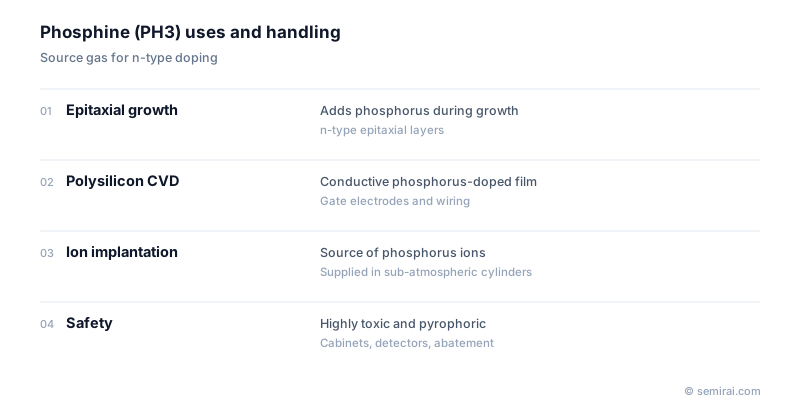
Where phosphine is used
In epitaxial growth and polysilicon CVD, a small amount of phosphine is mixed with the silicon source gas so that phosphorus is built into the film as it grows. This is called in-situ doping and gives n-type epitaxial layers or conductive polysilicon for gate electrodes and wiring.
In an ion implanter, phosphine is broken down in the ion source to produce phosphorus ions, which are then accelerated into the wafer. In MOCVD of III-V materials such as InP and InGaAsP, phosphine supplies the group 15 element and reacts with organometallic sources of indium or gallium.
Safety and handling
Phosphine is extremely toxic, dangerous even at very low concentrations, and can ignite spontaneously in air. In Japan it is regulated as a special high-pressure gas. It is usually supplied diluted in hydrogen or nitrogen and kept in gas cabinets with leak detectors and automatic shut-off valves, with double-walled piping.
For ion implantation, sub-atmospheric storage is widely used. The gas is adsorbed onto a porous material inside the cylinder and held below atmospheric pressure, so even if the cylinder or a line is damaged the gas does not rush out. Phosphine left in the tool exhaust is decomposed or adsorbed in abatement systems before release.
Japanese companies involved
- Taiyo Nippon Sanso supplies specialty gases and gas supply systems to semiconductor fabs, and also makes MOCVD equipment in which hydride gases are used.
- Taiyo Nippon Sanso · Specialty gases, gas supply systems and MOCVD equipment
FAQ
How do phosphine and arsine differ as dopants?
Both are hydride gases for n-type doping: phosphine adds phosphorus and arsine adds arsenic. Arsenic is heavier, so implanted arsenic stays shallow and suits shallow source and drain junctions. Phosphorus goes deeper and diffuses faster, so it suits wells and deeper regions. Both gases are extremely toxic.
What is sub-atmospheric gas storage?
It is a cylinder in which a toxic gas is adsorbed onto a porous material such as activated carbon and held below atmospheric pressure. The tool draws the gas out by vacuum. If something breaks, air tends to leak in rather than gas leaking out, which greatly reduces the hazard.
Related pages
Sources
Last updated: November 12, 2026