NRE (Non-Recurring Engineering) Cost
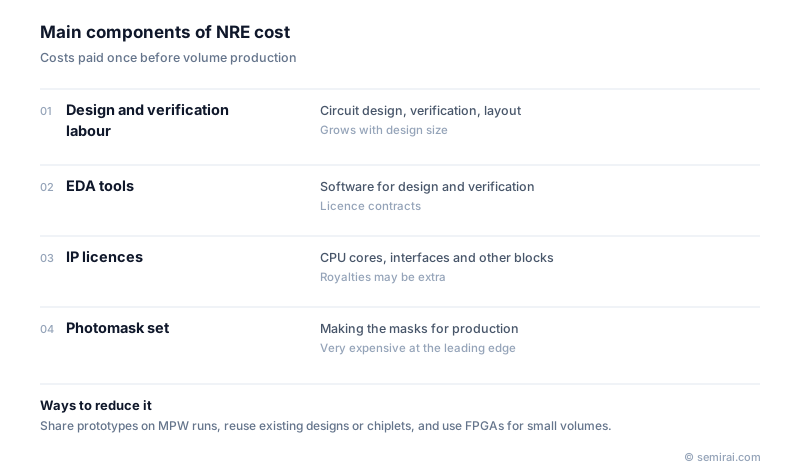
NRE (non-recurring engineering) cost is the one-time cost of developing a new chip before volume production starts. It includes design labour, EDA tool licences, IP licence fees, verification and the full set of photomasks needed for manufacturing. It is separate from the recurring cost of making each chip, and it has grown steeply with each new process generation.
Also called: NRE, non-recurring engineering, development cost
Diagram
Why NRE keeps rising
As processes advance, designs get bigger and design and verification take more engineering effort. At the same time, leading-edge processes need more lithography steps and therefore more masks, including expensive EUV masks. Mask sets for the most advanced nodes are reported to cost many millions of dollars, and total development cost including design is far higher. As a result, only companies with high-volume products can justify a dedicated chip on the newest processes.
IP licences and EDA tools for leading-edge nodes are also more expensive, and design teams must handle new effects such as complex design rules and variability.
NRE and the choice of implementation
NRE strongly influences how a product is built. At low volumes an FPGA, which needs almost no NRE, is cheaper overall even though each unit costs more. At high volumes an ASIC wins, because its lower unit cost outweighs the NRE. The crossover volume depends on the process node and the design.
Several approaches reduce NRE. Multi-project wafer (MPW) shuttles share mask cost for prototypes, reusing proven IP and earlier designs cuts design effort, and chiplets let a product combine existing dies rather than designing everything on one new chip. Structured ASICs and gate arrays, which customise only a few layers, were historically used for the same purpose.
Japanese companies involved
- Socionext designs custom SoCs for customers, a business in which it takes on part of the design work and NRE of developing a dedicated chip.
- Socionext · Fabless custom SoC design
FAQ
How does NRE affect the choice between ASIC and FPGA?
An ASIC has high NRE but a low unit cost, while an FPGA has almost no NRE but a high unit cost. Above a certain production volume the ASIC becomes cheaper in total, so companies estimate that break-even point when choosing.
Why is NRE highest at the leading edge?
Bigger designs need more design and verification work, more lithography layers need more masks, EUV masks are expensive, and licences for the newest IP and EDA tools cost more. All of these rise together with each new generation.
Related pages
Sources
Last updated: November 2, 2026