Semi-Damascene
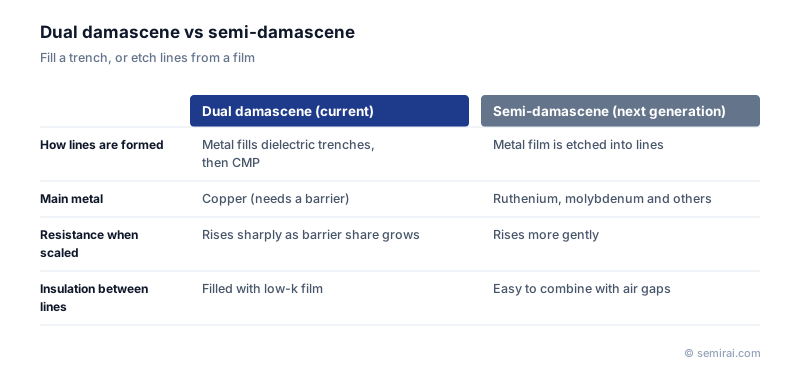
Semi-damascene is a proposed next-generation interconnect scheme in which vias are still made by the damascene method, filling holes with metal, but the lines above them are formed by depositing a metal film and etching it into lines. Only half of the process is damascene, hence the name. imec and others are developing it for interconnect pitches below about 20 nm.
Also called: semi-damascene metallization, subtractive interconnect
Diagram
Why copper dual damascene runs out
In today's copper dual damascene process, trenches and via holes are etched into the dielectric, a thin barrier and liner are deposited, copper fills the openings, and CMP removes the excess. As lines narrow, the barrier, which has a much higher resistivity than copper, takes up a growing share of the cross-section, and electrons scatter more at surfaces and grain boundaries. Resistance rises sharply. Copper also cannot easily be dry-etched into fine lines, so filling trenches is the only practical way to pattern it.
How semi-damascene works
Semi-damascene uses metals such as ruthenium or molybdenum, whose resistance rises more slowly in very narrow lines, which can be dry-etched, and which diffuse into dielectrics far less than copper, so they can be used with little or no barrier. After vias are filled, the same metal is deposited across the wafer and etched into lines, so via and line can form one continuous piece of metal with lower contact resistance.
Because the lines are etched from a film, the spaces between them can be closed with a cap rather than filled, leaving air gaps that reduce capacitance. The main challenges are etching high-aspect-ratio metal lines with clean profiles and controlling line shape and dimensions precisely.
Japanese companies involved
- Tokyo Electron supplies etch and deposition equipment of the kind needed for metal etching and thin-film formation in advanced interconnect development.
- Tokyo Electron (TEL) · Coat/develop, etch and deposition equipment
FAQ
How does semi-damascene differ from dual damascene?
Dual damascene etches both the via and line shapes into the dielectric and fills them with copper in one step. Semi-damascene fills only the vias and makes the lines by etching a metal film. Because the lines are etched, it uses metals such as ruthenium that can be dry-etched.
Why ruthenium instead of copper?
Copper is hard to dry-etch into fine lines and needs a barrier to stop it diffusing into the dielectric. Ruthenium can be etched, can work without a barrier, and its resistance rises less steeply than copper's in very narrow lines, so it can win at the tightest pitches.
When will semi-damascene be used in production?
It is still in development. It is being studied for the tightest metal layers of future logic generations, where copper's resistance becomes the limiting factor.
Related pages
Sources
Last updated: November 13, 2026