SoC (System on Chip)
An SoC (system on chip) is an integrated circuit that combines most of the functional blocks of a computer system on one silicon die: CPU cores, a GPU, an AI accelerator, memory controllers, interfaces and often wireless modems. Integration shortens the wiring between blocks, so an SoC is smaller, cheaper and more power-efficient than the same functions on separate chips.
Also called: system on a chip, system LSI
Diagram
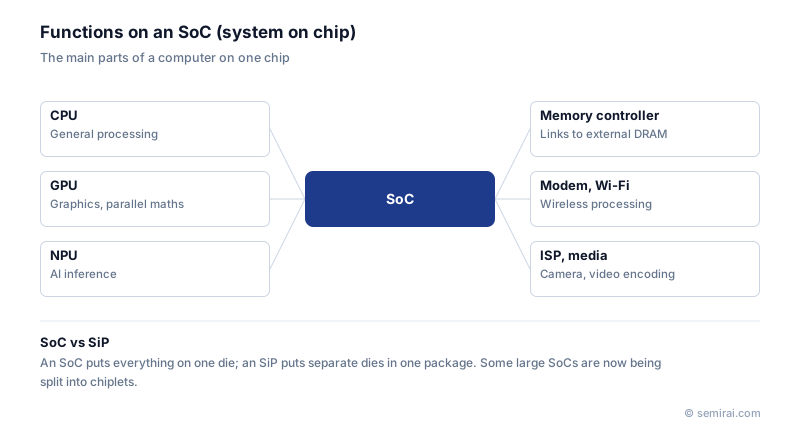
What is inside an SoC
A smartphone application processor is the typical example. It contains a cluster of CPU cores, usually mixing high-performance and high-efficiency cores, a GPU, a neural processing unit (NPU) for AI inference, an image signal processor (ISP) for the camera, video encoders and decoders, a memory controller for external LPDDR DRAM and, in many designs, the cellular and Wi-Fi modems. Automotive SoCs for driver assistance and cockpit systems, and microcontroller-class SoCs for IoT, follow the same idea at different scales.
Most blocks are not designed from scratch. Companies combine their own circuits with licensed intellectual property (IP) cores, such as Arm CPU cores or interface IP, and assemble them with EDA tools from RTL through to the GDSII layout.
How SoCs are manufactured
Flagship SoCs are made on the most advanced logic processes, which combine EUV lithography, FinFET or GAA transistors, atomic layer deposition of the gate stack and more than ten layers of copper wiring. Most SoC designers are fabless and have their chips made by a foundry.
Because the cost of a large die rises steeply at new nodes, some high-end designs are being split into chiplets connected inside one advanced package. The boundary between an SoC and a system in package is therefore blurring: the integration that used to happen on one die can now happen in one package.
Japanese companies involved
- Socionext designs custom SoCs for customers in automotive, data-centre and consumer markets as a fabless company.
- Renesas Electronics supplies automotive SoCs and microcontrollers for vehicle control and driver-assistance systems.
- Socionext · Fabless custom SoC design
- Renesas Electronics · Microcontrollers, automotive SoCs, analog and power chips
FAQ
What is the difference between an SoC and an SiP?
An SoC integrates functions on one silicon die. A system in package (SiP) places several separate dies, possibly made with different processes, inside one package. An SiP can mix technologies such as RF, memory and logic more easily, while an SoC gives the shortest connections.
What is the difference between an SoC and a microcontroller?
A microcontroller is a small SoC: a CPU core with on-chip flash, SRAM and peripherals for control tasks. The term SoC usually refers to larger chips that run a full operating system and use external DRAM.
Why are SoCs moving to chiplets?
A very large die has lower yield because each defect ruins a bigger area. Splitting it into smaller dies, and making parts such as I/O on cheaper mature processes, can cut cost, at the price of more complex packaging and die-to-die interfaces.
Comparisons
Related pages
Sources
Last updated: November 2, 2026