Threshold Voltage (Vth)
Threshold voltage (Vth) is the minimum gate-to-source voltage at which a MOSFET forms a conducting channel and begins to pass significant current between source and drain. It is one of the most important transistor parameters, because it sets the balance between switching speed and the leakage current that flows when the transistor is off.
Also called: Vth, Vt, gate threshold voltage
Diagram
What happens at the threshold
In an n-channel MOSFET on p-type silicon, a positive gate voltage first pushes holes away from the surface, leaving a depletion region. When the voltage reaches Vth, the surface becomes inverted: a thin layer rich in electrons connects source and drain, and current rises sharply. Below Vth a small subthreshold current still flows, falling exponentially as the gate voltage drops.
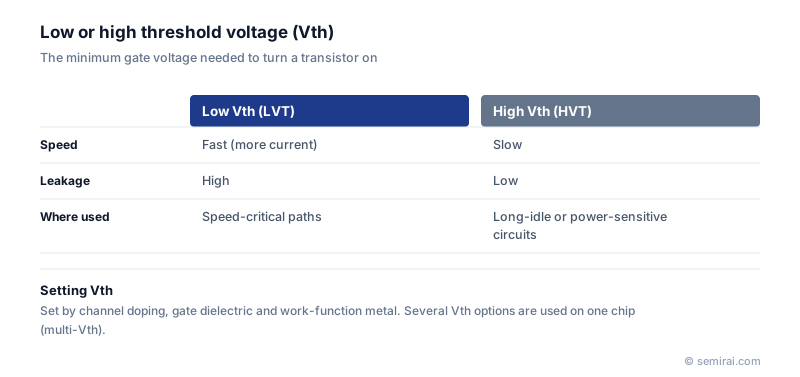
Vth is set by the gate dielectric (its thickness and dielectric constant), the work function of the gate electrode and the doping of the channel. In high-k metal gate processes, different work-function metals are used to place the thresholds of nMOS and pMOS transistors.
The speed and leakage trade-off
A low Vth gives more drive current at a given supply voltage, so circuits switch faster, but the off-state leakage rises steeply. A high Vth cuts leakage and standby power but slows the circuit. Advanced logic processes therefore offer several threshold options on one chip, such as ultra-low, low, standard and high Vt, and designers use fast low-Vt cells only on timing-critical paths.
As transistors shrink, Vth becomes harder to control. Random variation in the number and position of dopant atoms and in metal grain structure makes neighbouring transistors differ, which matters greatly for SRAM. In short channels the drain voltage also lowers the barrier at the source, an effect called drain-induced barrier lowering (DIBL), so Vth falls and off-current grows. Wrapping the gate around the channel, first in FinFETs and now in gate-all-around nanosheets, restores control.
FAQ
How is threshold voltage measured?
It is extracted from the drain current versus gate voltage curve. Common methods take the gate voltage at a fixed small current per unit width (the constant-current method) or extrapolate the linear part of the curve to zero current. Different methods give slightly different values, so the method is always stated.
Why does threshold voltage change with temperature?
In silicon MOSFETs Vth typically falls as temperature rises, by roughly a millivolt or a few millivolts per degree, because more carriers are thermally available. Leakage therefore increases sharply in hot chips, which is a concern for both data-centre and automotive designs.
What is threshold voltage in a power MOSFET datasheet?
Datasheets list a gate threshold voltage measured at a specified small drain current. It is not the voltage at which the device is fully on; to reach the rated low on-resistance the gate must be driven well above that value.
Related pages
Sources
Last updated: November 2, 2026