Operational Amplifier (Op-amp)
An operational amplifier (op-amp) is an amplifier that multiplies the voltage difference between its two inputs by a very large factor. It got its name from analog computers, where op-amps performed mathematical operations such as addition and integration. Today it is the most basic analog building block, used for sensor amplification, filters, voltage comparison and power supply control in almost every electronic device.
Also called: op-amp, opamp, operational amplifier
Diagram
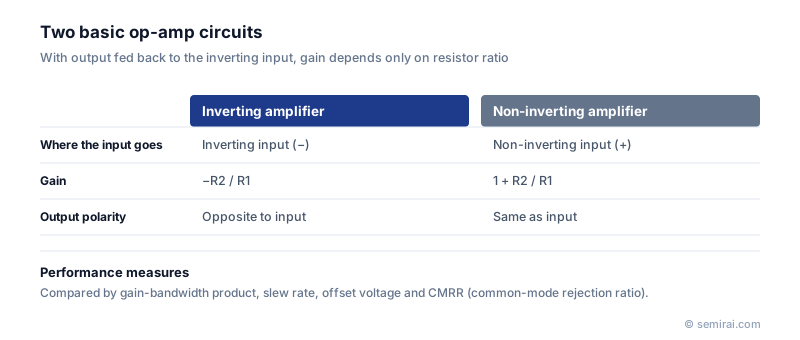
Negative feedback and gain
An ideal op-amp has infinite open-loop gain, infinite input impedance (no current flows into the inputs) and zero output impedance. Real op-amps have open-loop gains of 100,000 or more, so used on their own their output would immediately saturate at a supply rail. Instead they are used with negative feedback: part of the output is fed back through resistors to the inverting input.
The circuit's gain then depends only on the resistor ratio. An inverting amplifier has a gain of −R2/R1, and a non-inverting amplifier a gain of 1 + R2/R1. Because the result no longer depends on the op-amp's own gain, which varies between parts and with temperature, the amplification is accurate and stable.
Performance and types
Op-amps are compared by gain-bandwidth product (GBW), which sets the highest frequency they can amplify usefully; slew rate, the fastest speed at which the output can change; input offset voltage; common-mode rejection ratio (CMRR); noise; and supply current. Rail-to-rail op-amps let inputs and outputs swing close to both supply voltages, and chopper or zero-drift op-amps reduce offset to very small values for precision measurement.
Internally, an op-amp is a multistage amplifier whose input stage is a differential amplifier, followed by gain and output stages. They are built with bipolar transistors, CMOS or both.
Japanese companies involved
- ROHM and Renesas Electronics make general-purpose and precision op-amps for industrial, automotive and consumer equipment.
- Nisshinbo Micro Devices and Toshiba Electronic Devices & Storage also supply op-amps.
- ROHM · SiC and silicon power devices, analog ICs
- Renesas Electronics · Microcontrollers, automotive SoCs, analog and power chips
- Toshiba Electronic Devices & Storage · Power MOSFETs, IGBTs and discrete semiconductors
FAQ
Why is negative feedback used with op-amps?
On its own, an op-amp's gain is far too high and varies with each part and with temperature, so the output would simply hit a supply rail. Feeding part of the output back to the inverting input makes the gain depend only on external resistors, giving stable and accurate amplification.
Can an op-amp be used as a comparator?
It can, but it is not designed for it. An op-amp is optimised for linear operation with feedback; without feedback it may respond slowly as it comes out of saturation and its output may not match logic levels. A dedicated comparator is the better choice for fast, clean decisions.
Related pages
- Differential Amplifier
- Analog Circuit (Analog IC)
- Comparator
- ADC / DAC (Analog-to-Digital and Digital-to-Analog Converters)
- Bipolar Junction Transistor (BJT)
- MOSFET (Metal-Oxide-Semiconductor Field-Effect Transistor)
- Voltage Regulator
- Integrated Circuit (IC)
- Analog test systems
- Advantest EVA100
- Advantest V93000 Power and Analog Solutions
- Shibasoku PAMS-EXceed
- Shibasoku WL15V
Sources
Last updated: November 13, 2026