Oblique Illumination
Oblique illumination is lighting that strikes an object at an angle rather than straight down. In semiconductor manufacturing it has two important uses: off-axis illumination in exposure tools, which improves resolution and depth of focus, and dark-field illumination in defect inspection, which reveals tiny particles.
Also called: off-axis illumination (OAI), dark-field illumination
Diagram
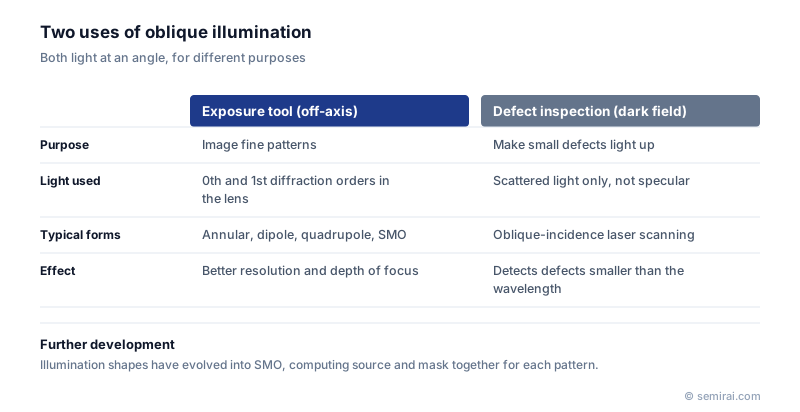
Off-axis illumination in exposure tools
A fine mask pattern diffracts light into several orders. With straight-on illumination, the 1st-order beams of a very fine pattern spread too wide to enter the projection lens, and no image forms. Tilting the illumination lets the 0th order and one of the 1st orders both pass through the lens and interfere, so finer pitches can be imaged with the same lens.
Common illumination shapes are annular (a ring), dipole (two poles) and quadrupole (four poles), chosen to suit the pattern. This has developed into source-mask optimisation (SMO), in which the illumination shape is calculated together with the mask pattern.
Dark-field illumination in defect inspection
Inspection tools shine light onto the wafer at a slant and detect only light scattered by defects, not the specular reflection. A flat surface reflects the beam away in one direction and appears dark, while particles and scratches scatter light and show up as bright points. Defects far smaller than the wavelength can be found this way.
Unpatterned wafer surface inspection tools, which count light point defects (LPDs), are built on this principle.
Japanese companies involved
- Nikon builds ArF, KrF and i-line exposure tools whose illuminators provide annular, dipole and other off-axis illumination settings.
- Nikon · ArF, KrF and i-line lithography systems
FAQ
Is there a downside to off-axis illumination?
Yes. A given illumination shape helps some pitches and orientations and can hurt others; a dipole that sharpens vertical lines does little for horizontal ones. Mixed layouts therefore need compromise shapes, assist features or optical proximity correction, and calculating the best shape for a layout is the job of SMO.
What is the difference between dark-field and bright-field inspection?
Bright-field inspection collects the directly reflected light and looks for changes in the image, which suits pattern defects. Dark-field collects only scattered light against a dark background, which is faster and very sensitive to particles. Fabs use both, matching the method to the defect type and layer.
Related pages
Sources
Last updated: November 1, 2026