Light Point Defect (LPD)
A light point defect (LPD) is any feature on the surface of an unpatterned wafer that scatters light from a scanning laser and is detected as a bright point. LPDs include particles, crystal-originated pits (COPs), scratches and bumps, and their count is the most basic measure of how clean a bare or film-coated wafer is.
Also called: LPD, localized light scatterer, LLS
Diagram
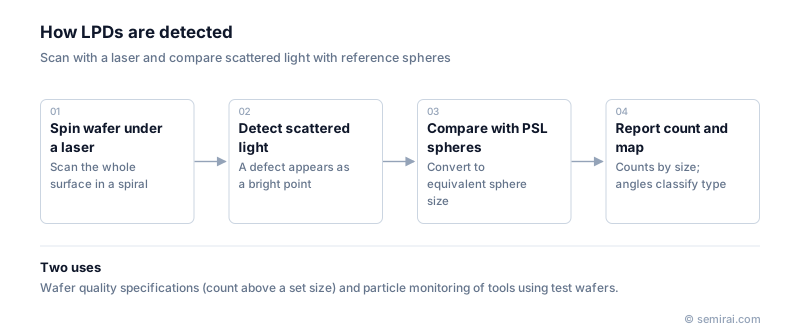
How LPDs are detected and sized
A surface inspection system, often called a particle counter, spins the wafer and scans a laser across it in a spiral. A defect scatters light into detectors placed at several angles, and the system records its position and signal strength. Comparing the signals from different angles helps separate particles from pits and scratches.
The tool does not measure the true size of a defect. It compares the scattered light with that from polystyrene latex (PSL) spheres of known diameter and reports an equivalent size, such as "PSL-equivalent 26 nm". A defect of different material or shape scatters differently, so its real size can differ from the reported value.
Two main uses
Wafer specifications limit LPDs: no more than a set number per wafer above a given PSL-equivalent size. Prime wafers for leading-edge processes are counted down to very small sizes, which pushes inspection tools toward shorter wavelengths and more sensitive optics.
LPD counts also monitor equipment. A clean bare wafer is measured, run through a tool and measured again, and the increase, often called particle adders, shows how many particles the tool sheds. Comparing counts before and after cleaning separates removable particles from crystal defects and scratches that cleaning cannot remove.
Japanese companies involved
- Hitachi High-Tech makes unpatterned wafer surface inspection systems that detect and classify light point defects.
- Hitachi High-Tech · CD-SEM metrology, defect inspection and etch systems
- Lasertec · EUV mask and mask blank inspection
FAQ
Is an LPD the same as a particle?
No. LPD is a detection-based category: anything that scatters light. Particles are one kind, but COPs, polishing scratches, residues and surface bumps are also LPDs. Multi-angle classification and before-and-after cleaning tests are used to tell them apart.
Why can't LPD inspection be used on patterned wafers?
Patterns themselves scatter strongly, which would swamp the small signal from a defect. Patterned wafers are inspected with different tools that compare each die with its neighbours or with a reference image, using brightfield or darkfield optics or electron beams.
Related pages
- Particle Contamination
- Final Polishing
- Microroughness
- Aerosol Cleaning (Cryogenic Aerosol)
- Oblique Illumination
- Wafer substrate inspection equipment
- Hitachi High-Tech DI4600
- Kobelco Research Institute EPM-2200
- Kobelco Research Institute LEP series
- Kobelco Research Institute SBW series flatness and shape measurement systems
Sources
Last updated: November 13, 2026