Spin Coating
Spin coating is a method that dispenses a liquid material onto the centre of a wafer and spins the wafer at high speed, so centrifugal force spreads the liquid into a thin, uniform film. It is the standard way to apply photoresist and is also used for anti-reflective coatings, spin-on glass, spin-on carbon and polyimide.
Also called: spin coat, spin-on coating
Diagram
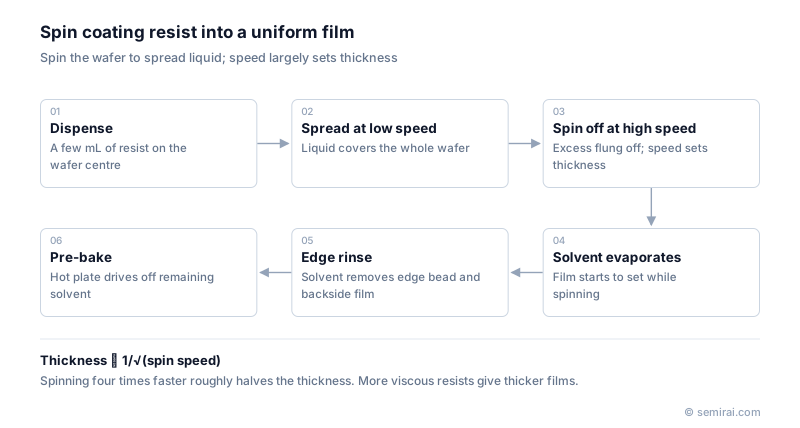
How spin coating works
The process runs in roughly four stages: a nozzle dispenses material onto the wafer centre; rotation spreads it to the edge; high-speed spinning throws off the excess and thins the film; and the solvent evaporates so the film begins to solidify. No vacuum chamber is needed and a uniform film forms in seconds.
Thickness depends mainly on spin speed and viscosity: faster spinning and thinner liquids give thinner films. As a rule of thumb, thickness is roughly inversely proportional to the square root of spin speed, so spinning four times faster halves the thickness. By choosing the material and speed, resist films from tens of nanometres to tens of micrometres can be made.
Spin coating in the coater/developer
Coating takes place in a unit of the coater/developer track. HMDS priming before coating improves adhesion, and a bake afterwards drives off the remaining solvent. Liquid piles up at the wafer rim into a thicker edge bead, which is removed with a solvent edge rinse.
Uniformity also depends on ambient temperature, humidity and exhaust airflow, not only on spin settings. Most of the dispensed material is flung off and wasted, so dispense recipes are tuned to use as little as possible.
Japanese companies involved
- Tokyo Electron and SCREEN Holdings make the coater/developer tracks in which photoresist is spin-coated, baked and developed.
- Tokyo Electron (TEL) · Coat/develop, etch and deposition equipment
- SCREEN Holdings · Wafer cleaning, coat/develop and inspection equipment
FAQ
What else affects spin-coated film thickness?
Besides speed and viscosity, the solvent's evaporation rate, spin time, acceleration profile, and the temperature and humidity of the cup all play a part. A faster-evaporating solvent sets the film earlier and leaves it thicker. Fabs therefore control the coating environment as tightly as the recipe.
What is an edge bead?
It is a ridge of thicker film at the wafer rim, where liquid flowing outward is held back by surface tension. Left in place it can cause focus errors and flake off as particles during handling, so the rim is cleaned with solvent in an edge bead removal step.
Related pages
- Coater/developer
- Photoresist
- HMDS (Hexamethyldisilazane)
- Spin-On Glass (SOG)
- Bottom Anti-Reflective Coating (BARC)
- Uniformity (Within-Wafer and Wafer-to-Wafer)
- Edge Bead Removal (EBR)
- Post-Exposure Bake (PEB)
- Photoresists
- FUJIFILM FAiRS series
- FUJIFILM GAR series
- FUJIFILM GKR series
- JSR ArF immersion photoresists
Sources
Last updated: November 12, 2026