Rayleigh Equation
The Rayleigh equations are the basic formulas for the finest resolution and the depth of focus achievable in lithography. Resolution is R = k₁ × λ / NA and depth of focus DOF = k₂ × λ / NA², where λ is the exposure wavelength, NA the numerical aperture of the projection lens, and k₁ and k₂ process-dependent factors.
Also called: Rayleigh criterion, Rayleigh resolution formula
Diagram
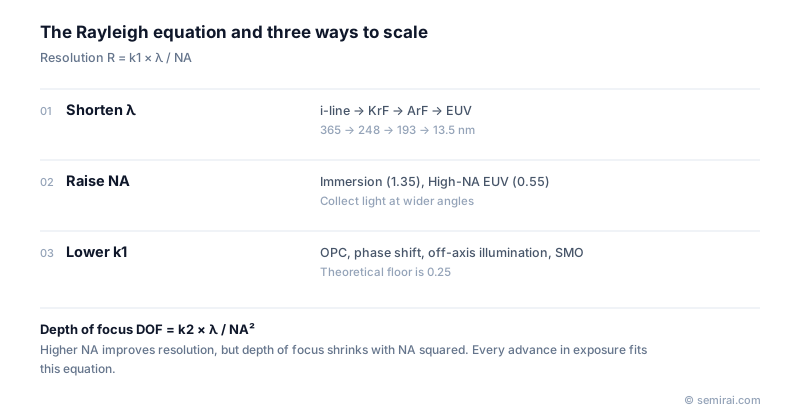
Three ways to print smaller
Shorten the wavelength. Lithography moved from g-line (436 nm) and i-line (365 nm) mercury lamps to KrF (248 nm) and ArF (193 nm) excimer lasers, and then to 13.5 nm EUV.
Raise the numerical aperture. Lens designs improved from below 0.5 to about 0.93 in dry ArF tools, water immersion took ArF to 1.35, and EUV is moving from 0.33 to 0.55 with High-NA tools.
Lower k₁. Resolution enhancement techniques such as optical proximity correction, phase-shift masks, off-axis illumination and source-mask optimisation push k₁ down. For a single exposure of lines and spaces the physical floor is 0.25; multi-patterning goes beyond it by splitting the pattern over several exposures.
The depth of focus trade-off
Depth of focus shrinks with the square of NA, so each increase in NA buys resolution at a steep cost in focus margin. A wafer with slight height variation, or a resist film that is not perfectly uniform, may fall outside the focus range.
This is why chemical mechanical polishing, wafer flatness, autofocus and levelling systems in the scanner, and thin resist films have all become more important as NA has risen. It is also one reason the move to EUV was attractive: a shorter wavelength improves resolution without the same loss of depth of focus that higher NA would cause.
Japanese companies involved
FAQ
What is the k₁ factor?
A number that captures everything other than wavelength and NA: illumination, mask type, resist and process control. Lower k₁ means a more aggressive process. Production values have fallen from well above 0.6 in early generations to around 0.3 or a little below today.
Why does depth of focus depend on NA squared?
Higher NA brings light to the focus from steeper angles. A small shift along the optical axis then produces a larger path difference between rays, so the image blurs faster as it moves away from best focus.
Who was Rayleigh?
Lord Rayleigh, a British physicist who in the 19th century defined the criterion for when two point images can be distinguished. Lithography adapted his idea, adding the empirical k₁ factor to describe what a real process can print.
Related pages
Sources
Last updated: November 2, 2026